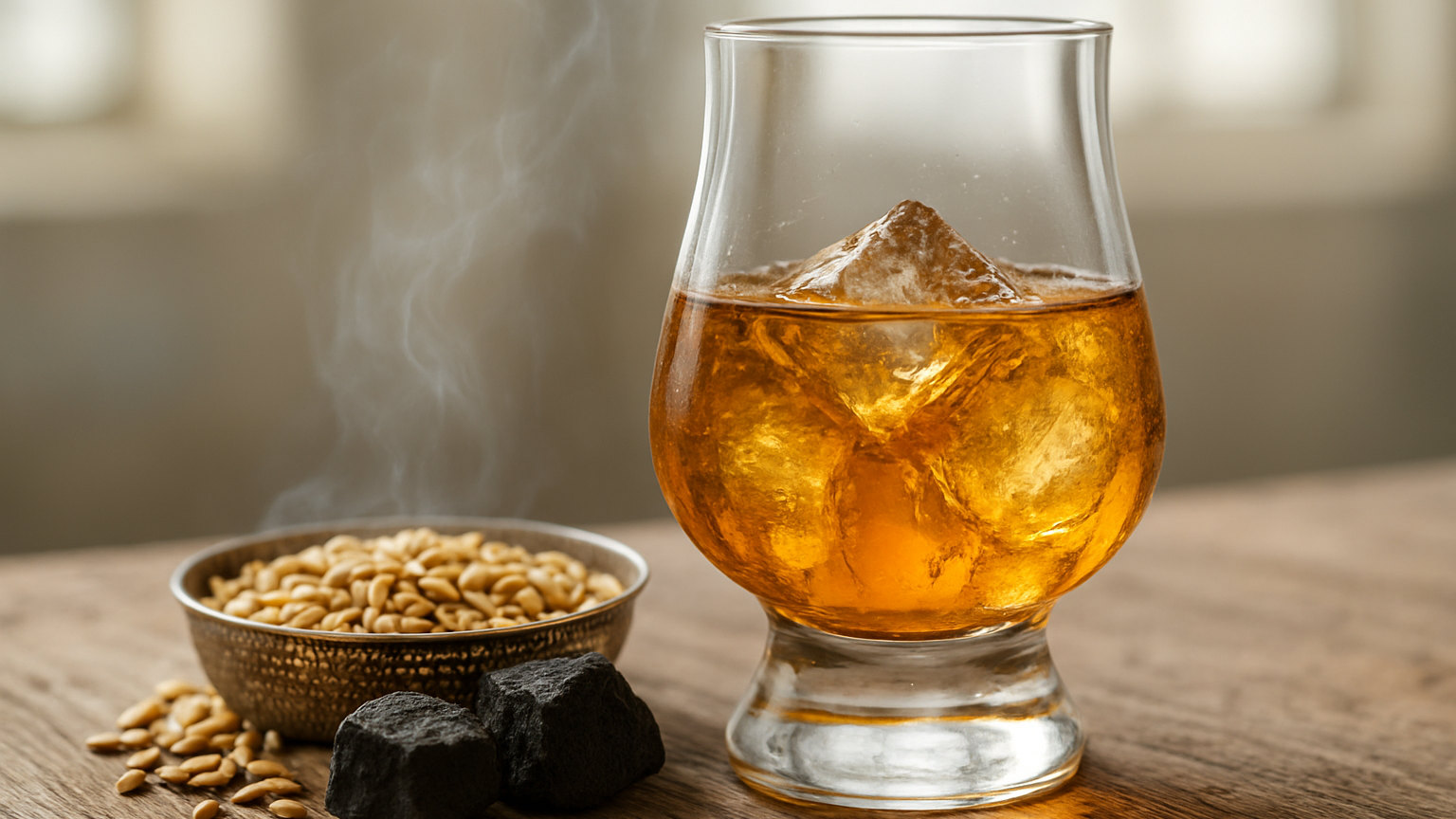
Smoke in whisky is not added to the spirit, not created in the still and not contributed by the cask. It comes from a single stage at the very beginning of the process, and understanding that stage explains why some whiskies are intensely smoky and most are not smoky at all.
What is peat?
Peat is partially decomposed vegetation, mostly mosses, heather and grasses, that has accumulated in waterlogged ground over thousands of years. Because the ground is wet and low in oxygen, the material never fully decays. Cut into blocks and dried, it burns slowly and produces a dense aromatic smoke.
It was used as fuel across Scotland and Ireland for centuries simply because it was available where trees were not, which is why peated whisky is a regional accident rather than a design decision.
At what point does the smoke get in?
During malting. Barley is soaked until it germinates, then dried in a kiln to halt the process. If peat is burned in that kiln, the smoke passes over the damp grain and phenolic compounds stick to it.
Those phenols survive milling, mashing, fermentation, distillation and years of maturation. Nothing after the kiln adds smoke, and the amount of peat burned during those hours of drying determines how smoky the whisky will be for the rest of its life.
What does ppm mean on the label?
Phenol content is measured in parts per million. The figure usually quoted refers to the malted barley before distillation rather than to the whisky in the bottle, and a considerable proportion is lost during production. A malt specified at 50 ppm might yield a spirit at roughly half that.
- 0 to 5 ppm: effectively unpeated, which covers the majority of Scotch.
- 10 to 20 ppm: lightly peated, where smoke is a background note rather than the point.
- 25 to 50 ppm: the classic Islay range, clearly smoky.
- 50 ppm and above: heavily peated, with a few releases going far higher as a deliberate statement.
Numbers only compare usefully within a producer's own range, since measurement points and losses differ between distilleries.
Why does peated whisky taste different in different places?
Peat composition varies with what grew there. Island peat, formed from coastal vegetation and exposed to sea spray, tends to produce the medicinal, iodine and seaweed notes associated with Islay. Inland and Highland peat, containing more wood and heather, gives a drier, earthier, more bonfire-like smoke.
This is why two whiskies at similar phenol levels can smell entirely unalike, one like a hospital and the other like a campfire.
Is all Islay whisky peated?
No. The island has a strong association with peat and several distilleries at the intense end of the scale, but it also produces lightly peated and effectively unpeated whisky. Meanwhile peated malt is produced across Scotland, on Skye, in the Highlands and in Speyside, and peated expressions appear from producers otherwise known for delicate styles.
Peating is a choice made at the maltings, so any distillery can order peated malt if it wants it.
Does smoke fade with age?
Yes, gradually. Phenols slowly diminish over long maturation, so a heavily peated whisky at twenty five years old is usually gentler and more integrated than the same spirit at eight. The smoke becomes one element among many rather than the leading one, which some drinkers prefer and others feel misses the point.
How should you approach peat for the first time?
Start with something lightly peated rather than at the extreme end, and try it alongside an unpeated whisky so you can identify what the smoke is actually doing. Give it more than one sip, because the first is usually a shock and the third rarely is.
Peated whisky also works remarkably well with food, particularly smoked fish, strong blue cheese and oysters, where the salt and smoke meet each other on equal terms. If you find a peated dram difficult neat, trying it with food is often the moment it makes sense.