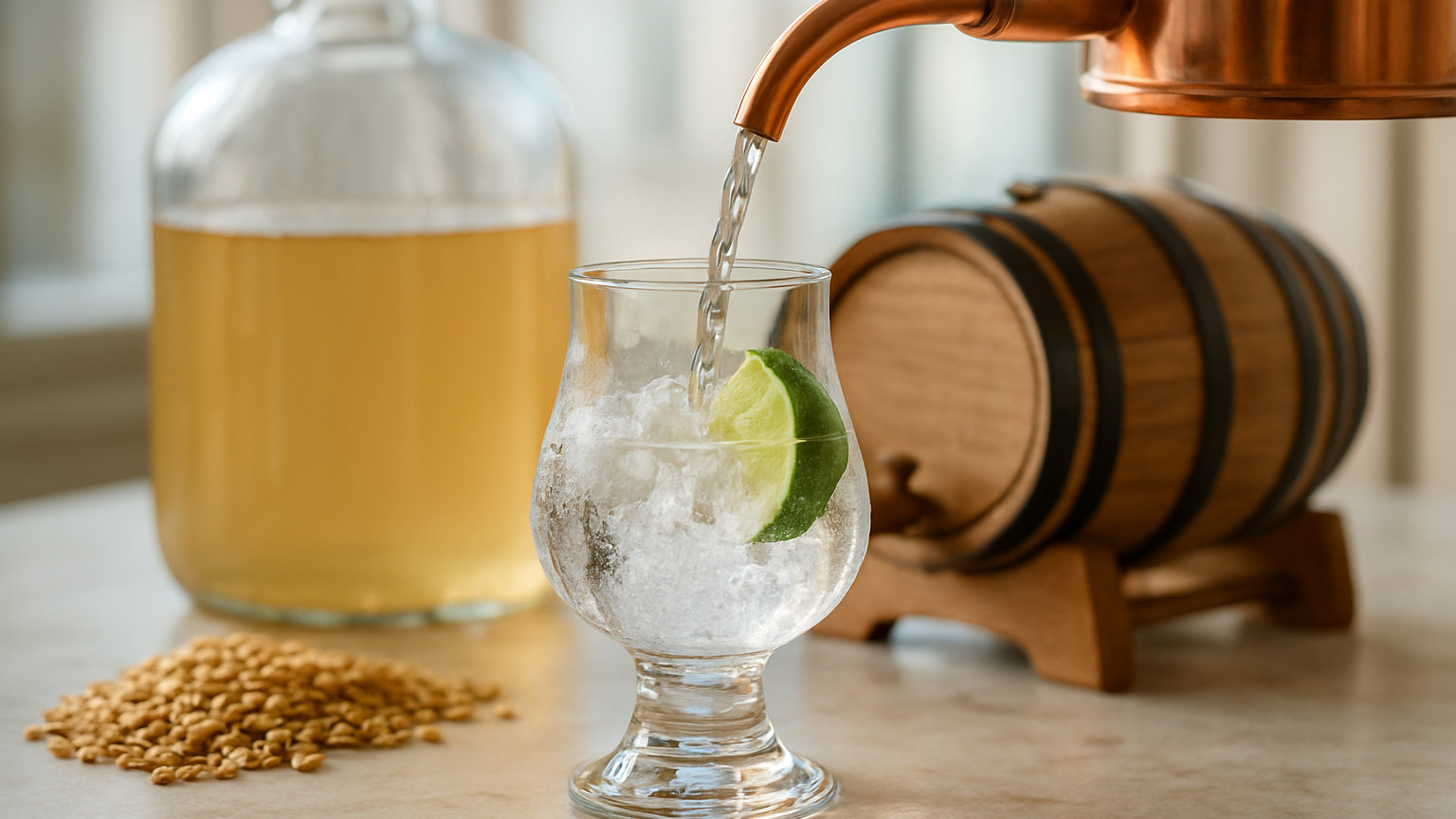
Every spirit is made in four stages: something sugary is fermented, the resulting liquid is distilled, the spirit is usually matured, and it is then reduced with water and bottled. The differences between categories are decided almost entirely at the first and third stages.
Stage one: fermentation
Yeast converts sugar into alcohol and carbon dioxide. Every alcoholic drink starts here.
What varies is where the sugar comes from. Grapes and other fruit contain sugar directly. Sugarcane contains it in the form of juice or molasses. Agave stores it as a starch-like carbohydrate that has to be cooked to release it. Grain stores it as starch, which must be converted to sugar by malting and mashing before yeast can do anything with it.
Fermentation typically produces a liquid somewhere between five and ten per cent alcohol. In whisky production this is essentially an unhopped beer; in brandy production it is wine.
Fermentation is not merely a means of producing alcohol. It creates a great many aromatic compounds, and a longer fermentation with particular yeasts is one of the main ways producers build character before distillation has even begun.
Stage two: distillation
Alcohol boils at a lower temperature than water, so heating a fermented liquid produces a vapour richer in alcohol. Cooling that vapour back to liquid gives a stronger spirit.
It is a separation rather than a creation. Distillation concentrates what fermentation produced; it cannot add anything that was not there.
Pot stills
A pot still is a batch process. A quantity of liquid is heated, the vapour is collected, and the still is emptied and refilled.
Pot stills are inefficient at separating alcohol from everything else, which is precisely why they are used for characterful spirits. A good deal of flavour carries over.
Single malt Scotch, cognac and many rums are pot distilled, frequently twice or three times.
Column stills
A column still runs continuously, with liquid fed in and vapour rising through a series of plates. Each plate acts as another round of distillation.
The result is a much higher strength and a much cleaner spirit. Column stills are used for vodka, most grain whisky and a great deal of rum.
Neither type is better. They are tools for different outcomes, and many producers use both and blend the results.
Cuts
The distiller divides the run into three parts. The heads come off first and contain volatile compounds that are unpleasant. The heart is the usable middle portion. The tails come last and are heavier and oilier.
Where the distiller makes those cuts is one of the most consequential decisions in the whole process, and a wider cut gives a heavier, more characterful spirit while a narrower one gives a cleaner spirit and less of it.
Stage three: maturation
Where brown spirits get most of their character.
Oak contributes colour, vanilla, spice and tannin. It also allows slow oxidation through the wood, which softens the spirit, and evaporation, which concentrates what remains.
A cask that previously held sherry, bourbon or wine contributes flavour from that too, which is why cask type appears so prominently on modern labels.
Maturation is not simply a matter of time. Climate matters enormously: a spirit in a hot climate interacts with wood far faster, so a four year old rum from the Caribbean may have had more wood influence than a twelve year old Scotch.
The amount lost to evaporation each year is called the angels' share.
Unaged spirits skip this stage entirely, which is why vodka, gin, white rum and blanco tequila are clear.
Stage four: reduction and bottling
Spirit comes off the still far stronger than it is sold, so water is added to bring it to bottling strength.
Most spirits are reduced to forty per cent, which is the legal minimum for several categories and the cheapest option, since duty is charged on alcohol content and water is cheaper than spirit.
Many are also chill filtered, which removes compounds that would make the spirit hazy when cold. It also removes some texture, which is why unfiltered bottlings are usually at forty six per cent or above, where hazing is unlikely.
Cask strength means bottled without reduction, at whatever strength the cask reached.
Where gin is different
Gin is the exception, because its defining stage happens after distillation of the base spirit.
A neutral spirit is redistilled with botanicals, either steeped in the liquid or suspended in a basket so the vapour passes through them. Juniper must dominate.
This is why gin can be made anywhere and why the category is so varied. See our gin guides for how the styles differ.
Why this matters when buying
Because it tells you which claims mean something.
Age statements refer to the youngest spirit in the bottle, and in a hot climate a low number may still mean substantial wood influence.
Small batch and handcrafted have no legal definition in most markets.
Pot distilled, unfiltered, cask strength and one hundred per cent agave all describe real production decisions.
Our guides to whisky, rum and brandy and cognac go through what each category's labels actually guarantee.
Does the still shape matter?
Genuinely, yes, and more than most equipment claims in drinks.
A tall still with a long neck gives vapour further to travel, so heavier compounds condense and fall back rather than carrying over. The result is a lighter, cleaner spirit.
A short, squat still lets more of those heavier compounds through, giving an oilier, fuller spirit.
Distilleries generally replicate the exact dents and repairs of an old still when replacing it, on the reasonable assumption that the shape is part of the house character.