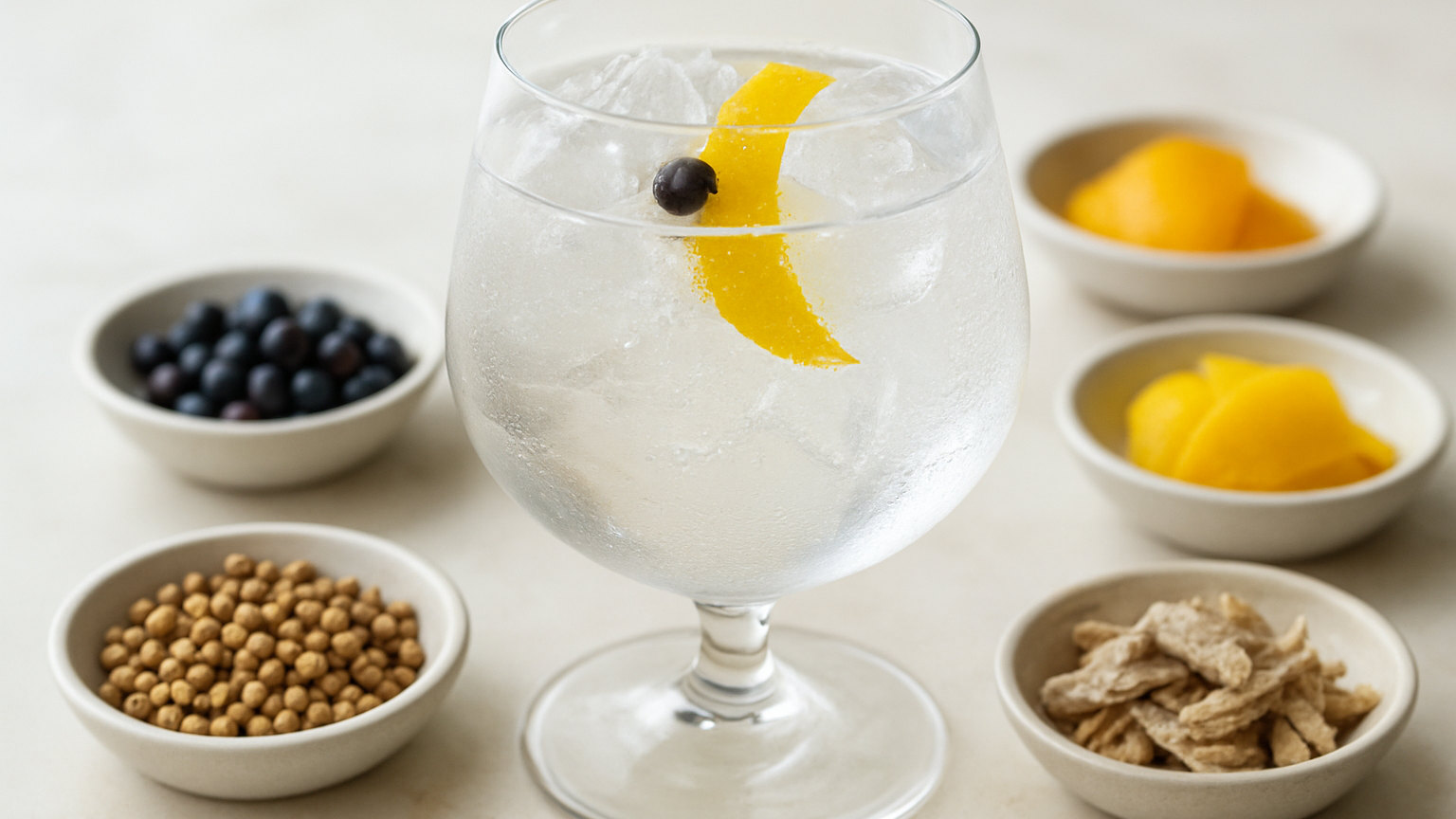
A typical gin contains between six and a dozen botanicals, and the great majority of gins share four or five of them. Once you know what the common ones do, the list on the back of a bottle becomes a reasonably accurate forecast of what is inside.
What does juniper contribute?
Juniper is compulsory and must be the predominant flavour for the spirit to be gin at all. The berries, which are botanically cones rather than berries, give the pine and resin note everyone recognises, along with a dry green freshness and a faintly peppery finish.
Juniper is not uniform. Berries from Italy, Macedonia, Bulgaria and elsewhere vary with altitude, soil and harvest year, and distillers select their source with the same care a whisky producer applies to casks. Most juniper is still gathered from wild bushes rather than farmed.
Which botanicals appear in almost every gin?
- Coriander seed. The second most common botanical by a wide margin. It brings lemon, sage and a warm spice, and it bridges the gap between juniper and citrus.
- Angelica root. Earthy, dry and slightly musky. Its main job is technical rather than flavourful: it acts as a fixative, binding the volatile aromatics so they hold together instead of dissipating.
- Orris root. The dried rhizome of the iris, used in tiny quantities for the same fixative purpose, plus a soft violet and powdery note.
- Citrus peel. Lemon, orange, grapefruit or bitter orange, usually dried. Provides brightness and lift, and is the botanical most often used to give a gin its individual signature.
- Liquorice root. Adds sweetness without sugar, along with a soft anise note and a rounder texture.
A gin built from those five plus juniper would be a competent classic London dry. Almost everything else on a modern label is a variation on top of that foundation.
What do the less common botanicals do?
Cassia bark and cinnamon add warm sweet spice. Cardamom gives a distinctive perfumed note that carries strongly, so it is used sparingly. Grains of paradise contribute a peppery heat. Almond adds a marzipan softness and body.
Beyond those, the modern category is wide open. Cucumber, rose, elderflower, seaweed, pine, tea, lavender, pepper, hops and local wild plants all appear. Producers frequently build a story around one signature botanical, and it is usually the one named on the front label.
Does more botanicals mean better gin?
No, and often the opposite. Botanicals compete for the same aromatic space, and a recipe with thirty of them tends to blur into a general perfume where nothing is distinct. Some of the most highly regarded gins use six or seven.
The number is a marketing figure more than a quality signal. What matters is balance, and specifically whether juniper is still leading. A gin where the signature botanical has buried the juniper may be pleasant, but it has stopped doing the thing gin does.
Why are some botanicals distilled separately?
Different plants give up their flavour at different rates and temperatures. Delicate florals and fresh citrus can be destroyed by the same long hot distillation that is needed to extract juniper and angelica root fully.
Distilling separately and blending afterwards, or vapour infusing the fragile botanicals while steeping the robust ones, solves this. It is why many gins with fresh fruit or flower character use a combination of methods rather than putting everything in one pot.
How do you use the botanical list when buying?
Read for the emphasis rather than the length. Heavy citrus suggests a gin that will shine in a gin and tonic and with a citrus garnish. Prominent root botanicals and pepper suggest weight and dryness, which suits a martini or a negroni. Floral and cucumber notes point to a lighter gin best served long and lightly garnished.
If the list is not published, the front label almost always tells you the intended direction anyway, and the price bracket tells you whether the flavour arrived through a still or out of a bottle of essence.