
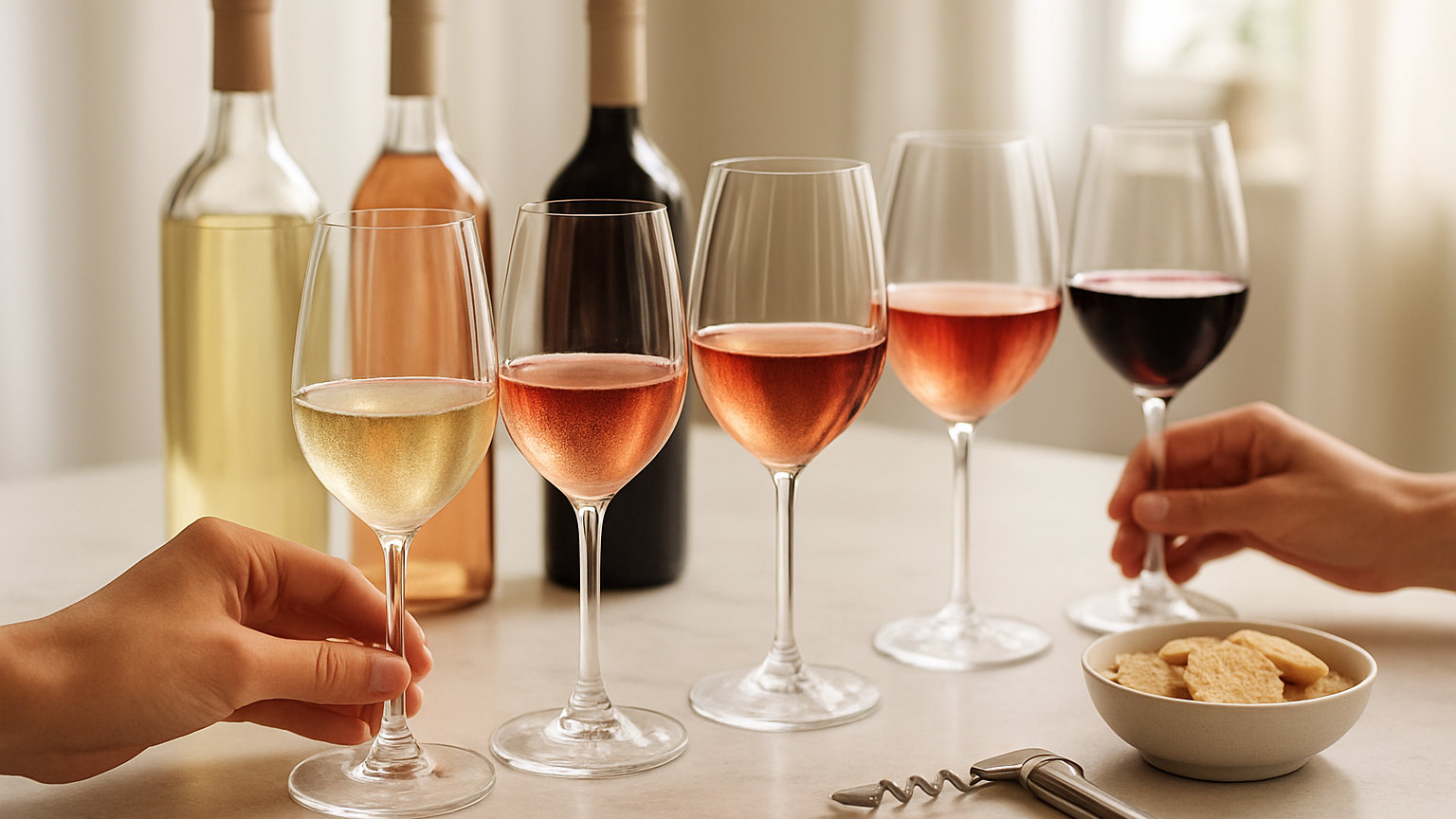
Tasting several wines side by side is the fastest way to learn anything about wine, because differences are far easier to perceive than absolutes. A single bottle drunk over an evening tells you whether you enjoyed it. Four bottles compared directly tells you why.
A home tasting requires very little organisation and is considerably cheaper than the equivalent commercial event.
The numbers
Six to eight people and five or six wines is the practical sweet spot. A bottle poured at fifty to seventy five millilitres yields ten to fifteen tastes, so five bottles comfortably serves eight people with wine left over for the drinking afterwards.
Beyond six wines, palate fatigue sets in and the later bottles are wasted. Beyond eight people, pouring becomes a job and conversation fragments.
Glasses are the usual constraint. One per person per wine is ideal and rarely available, so plan for two or three each and rinse between flights with a splash of the next wine rather than with water.
Choosing a theme
The theme is what makes a tasting instructive rather than merely a way of opening several bottles. The principle is to hold everything constant except one variable.
One grape from several countries is the classic and the most useful: five sauvignon blancs from the Loire, Marlborough, Chile, South Africa and England demonstrates climate and winemaking with unusual clarity.
One region across several grapes works well too, as does a vertical of the same wine across several vintages if you can assemble one. A price ladder, with the same style at five, ten, fifteen and twenty five pounds, is genuinely revealing and often uncomfortable.
Oaked against unoaked chardonnay, or the same producer's entry and premium bottling, both isolate a single decision neatly.
Running the evening
Pour small measures and pour them all before anyone starts, so people can move back and forth between glasses. Comparison is the whole point and is impossible if the first wine has been drunk before the second arrives.
Order matters: light before heavy, dry before sweet, young before old. Number the glasses, or use a printed sheet with circles to stand the glasses on, which sounds fussy and prevents a great deal of confusion.
Provide water, plain bread or crackers, and somewhere to spit or pour away. Strongly flavoured food should wait until afterwards, since cheese in particular flatters wine substantially and will distort everyone's impressions.
Ask people to write one line per wine before anyone speaks. Opinions expressed aloud early will anchor the whole room.
Blind or not
Blind tasting, with bottles in bags or foil, is worth doing at least once, because expectation shapes perception more than most people believe. Price and reputation genuinely change how much someone enjoys the same wine.
A semi-blind format works well socially: reveal the theme and the five wines involved but not which glass is which, and ask people to match them. It preserves the surprise without leaving anyone entirely at sea.
Reveal at the end, and expect at least one person to have preferred the cheapest bottle. That is the most valuable outcome of the evening rather than an embarrassment.
The point of it
What people take away is not a set of tasting notes but a calibration. They learn what they mean when they say a wine is too sharp, what oak actually tastes like, and whether spending twenty five pounds does anything for them personally.
That is worth considerably more than a professionally run event, costs the price of five bottles split between eight people, and can be repeated with a different theme whenever anyone fancies it.


