Wine storage advice usually assumes a cellar, which almost nobody has. The useful question is not how to build ideal conditions but which conditions actually matter and how much damage the realistic alternatives do.
Four factors are involved: temperature, light, humidity and vibration. They are not equally important, and knowing the order of priority makes the decision straightforward.
Temperature, and the part that matters most
The textbook figure is somewhere between ten and fifteen degrees. What matters considerably more than the exact number is stability.
Wine expands and contracts as temperature changes, and a bottle that goes through repeated cycles pushes wine past the cork and draws air back in. Over months and years that admits oxygen and ages the wine prematurely. A constant eighteen degrees does less harm than a range swinging between eight and twenty two.
Sustained heat is separately damaging. Above about twenty five degrees, chemical reactions accelerate to the point where a wine becomes cooked and stewed, and the change cannot be reversed. This is why a summer loft or a car boot is genuinely destructive rather than merely suboptimal.
Cold is more forgiving. A wine stored too cold simply matures very slowly, and only actual freezing causes damage by pushing the cork out.
Light and where it does harm
Ultraviolet light degrades compounds in wine and produces a fault known as light strike, which smells of cooked cabbage or wet wool. Sparkling wine and white wine in clear bottles are most vulnerable, which is why serious producers use dark glass.
The practical instruction is to keep bottles out of direct sunlight and away from fluorescent lighting. A wine rack in a sunny kitchen window is the single worst piece of furniture in the wine world, and a wine displayed there for a summer will be noticeably damaged.
Humidity and vibration
Humidity matters only for bottles sealed with natural cork and only over years. Very dry air can dry a cork out from the outside, shrinking it and breaking the seal. Somewhere around sixty to seventy per cent is the usual recommendation, though the range is wide.
In a British house this is rarely a problem, and it is irrelevant entirely for screwcapped wine or for anything you will drink within a year.
Vibration is the least significant of the four for domestic purposes. It is worth avoiding constant sources such as the top of a fridge or a washing machine, but a bottle in a cupboard near a door is not being harmed.
Where to put it in a real house
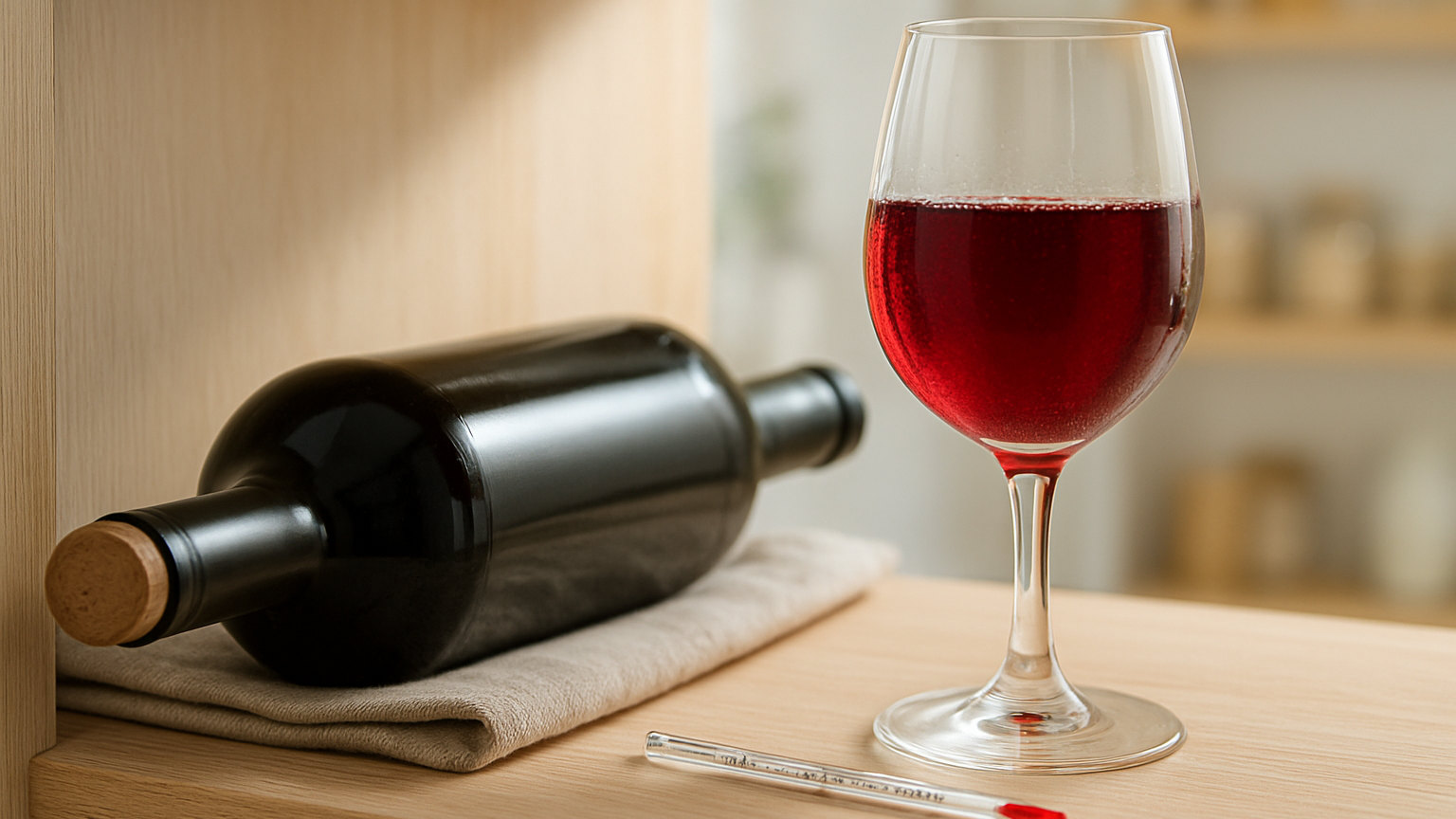
The best domestic locations are an understairs cupboard, a north-facing internal cupboard, a spare room away from radiators, or a cool utility room. Anywhere on an outside north wall, away from heat sources and windows, is a reasonable candidate.
The worst are the kitchen, which swings from cold overnight to very warm during cooking, a cupboard above or beside an oven, a loft, an uninsulated garage, and a conservatory. All of these produce large temperature ranges, which is the thing to avoid.
A domestic fridge is fine for a few days but not for storage, being too cold, too dry and subject to vibration and light every time the door opens.
How much of this you actually need
Proportion matters here. If a bottle is going to be drunk within a few weeks, almost none of this applies and a rack on a worktop is fine.
If wine sits for six months to a couple of years, avoid heat and light and stop worrying about the rest. If you intend to keep bottles for five years or more, the conditions become genuinely important and are worth solving properly, either with a dedicated cool space or with a wine fridge.
The single most useful habit for anyone without ideal storage is simply to buy wine closer to when you intend to drink it. A modest home stock that turns over regularly is easier to look after than a large one that sits, and it removes most of the problem rather than managing it.