
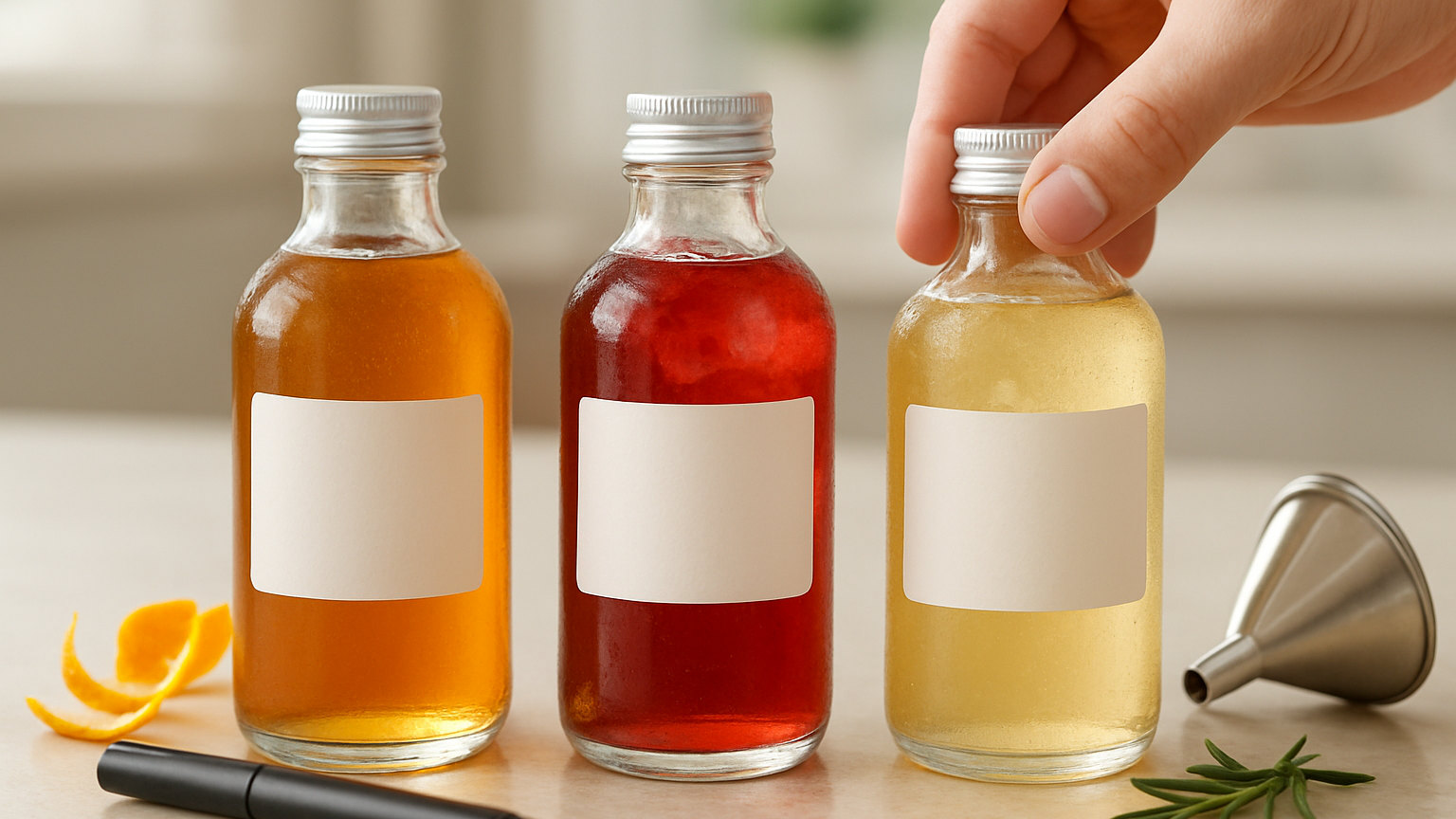
Making your own syrups and infusions produces a collection of bottles that look broadly alike and behave very differently. Managing that is unglamorous and it is what makes the whole exercise worthwhile rather than wasteful.
What goes on a label
Four things, and all four matter.
What it is, specifically. Not syrup but demerara syrup or honey ginger syrup.
The date it was made.
Any allergens, which is the one most often left off.
The alcohol content if there is any, which matters for a tincture, a batched cocktail or a spirit infusion.
Masking tape and a pen is entirely sufficient. Nothing about this needs to look presentable.
The allergen point
A homemade ingredient gives no indication of what is in it.
Orgeat contains almonds. Falernum usually does. A clarified milk punch contains dairy. A sesame-washed spirit contains sesame. A syrup made with honey is unsuitable for infants and for anyone avoiding it.
None of that is visible, and anyone else in the household or anyone you serve needs to be able to tell.
Write it on the bottle and say it when you serve a drink containing it.
Alcohol content
The other invisible property.
A tincture is high-strength spirit. A batched cocktail may be thirty per cent. An infused spirit is whatever it started as.
An unmarked bottle in a fridge tells nobody any of that, which matters for anyone avoiding alcohol, anyone driving and anyone else in the house.
Writing the strength per serving on a batched cocktail is a habit worth adopting.
Where things live
Refrigerate anything with sugar, fruit, dairy or fresh ingredients: syrups, cordials, grenadine, orgeat, shrubs and any batched drink containing vermouth.
Cupboard storage suits high-strength tinctures, bitters and infused spirits, which are preserved by their own alcohol content.
Freezer storage suits portioned syrups and high-strength batched cocktails.
Keep everything out of direct light, which degrades aromatics and colour.
Bottles
Clean, sealing properly, and filled close to the neck, since air in the bottle is what dulls the contents.
Small bottles are better than large half-empty ones for the same reason.
Rinse with boiling water and dry completely before filling anything you intend to keep for more than a week or two.
Dark glass is better for anything sensitive to light, and a dark cupboard achieves the same thing.
Rough shelf lives
Worth keeping in view when deciding how much to make.
Rich syrup: several months refrigerated.
Simple syrup: around a month.
Flavoured syrups with fresh ingredients: one to two weeks.
Cordials and grenadine: one to three weeks.
Orgeat: around two weeks.
Infused spirits and tinctures: effectively indefinite.
Batched cocktails with vermouth: weeks refrigerated. With citrus: hours.
Reviewing the shelf
The habit that prevents most of the waste.
Look at what is there once a month, check the dates, and discard anything past it.
Anything cloudy, fizzing or smelling of fermentation should go regardless of the date.
And be honest about what is actually being used. A shelf of six flavoured syrups made enthusiastically and used once is a sign to make smaller quantities of fewer things.
The overall approach
Make less, more often. Label everything. Refrigerate anything perishable. Fill bottles to the neck. Review the shelf occasionally.
None of it takes any time and together it is the difference between a useful collection and a fridge door full of unidentified liquid.
A note for shared households
Where a fridge is shared, labelling stops being a convenience and becomes necessary.
Someone else in the house may reasonably assume an unmarked bottle is a soft drink, which is a good reason to write the alcohol content on anything containing it.
Keeping it manageable
A collection of four or five things you use regularly is more useful than a dozen made once.
Which is an argument for making small quantities of fewer things, and for finishing one before starting the next.
Disposal
Pour spoiled syrup down a drain with plenty of water rather than into a compost bin, since sugar attracts pests.
Rinse the bottle immediately, since dried syrup sets hard and is considerably harder to remove later.


