
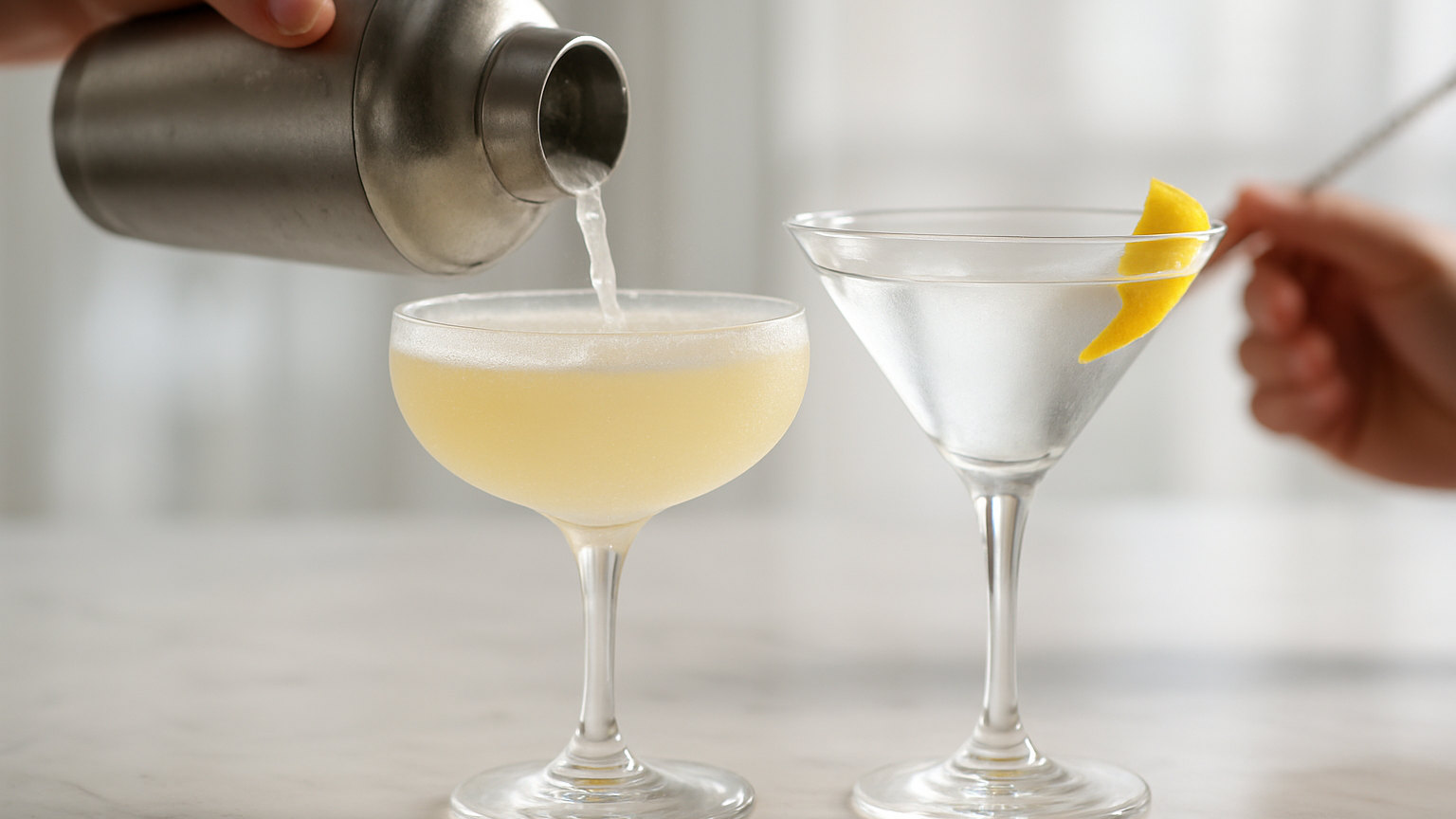
Shake anything containing citrus, dairy, egg or fruit. Stir anything made entirely of spirits, fortified wines and liqueurs. That covers almost every situation you will encounter.
The reasoning
Some ingredients combine on their own and some do not.
Spirits, liqueurs and fortified wines are all alcohol-based and mix readily. Gentle agitation is enough to combine them, and anything more vigorous adds air that is not wanted.
Citrus juice, egg white, cream and fruit purée are water-based or protein-based, and they need to be forced into suspension with the alcohol. Without violent agitation they sit awkwardly against it, and the drink tastes separated.
So the question is not whether a drink should be cold, since both techniques achieve that. It is whether anything needs emulsifying.
What shaking produces
A cloudy drink with a lighter texture and a slight foam.
The cloudiness comes from aeration and from tiny ice fragments, both of which are desirable in a sour and undesirable in a martini.
Shaking also chills faster and dilutes more, since the agitation maximises contact between liquid and ice.
Ten to fifteen seconds of genuine effort is the target.
What stirring produces
A clear drink with a dense, silky texture.
Spirit-forward cocktails are meant to feel weighty in the mouth, and aeration works against that by lightening them.
Stirring dilutes more slowly and more predictably, which suits drinks where the balance is precise.
Thirty seconds is the usual figure, or until the outside of the mixing glass frosts.
The awkward cases
A few drinks sit between the two and are worth knowing about.
A drink with a small amount of citrus, perhaps a teaspoon, can be stirred without much harm, and shaking is safer.
Anything with a substantial quantity of sugar syrup and no citrus, such as an old fashioned, is stirred despite the syrup, since sugar dissolves readily.
A drink with pineapple juice is shaken, and hard, since pineapple foams and the foam is part of the appeal.
Anything with tomato juice is rolled rather than shaken, since shaking whips it into an unpleasant froth.
The martini question
The most discussed exception and the least consequential.
Shaking a martini produces a colder, more diluted, cloudier drink with a lighter texture. Some people prefer that, and asking for it is entirely reasonable.
The claim that shaking bruises the gin is not chemistry. Nothing in gin is damaged by agitation.
What changes is clarity and texture, both of which are real. A gin martini loses the silky quality that is much of the point, which is why bars stir by default.
The other techniques
Rolling means pouring between two vessels several times, combining and chilling without aerating. Correct for a bloody mary.
Building means assembling in the serving glass with no separate mixing at all, which is how highballs are made.
Throwing is a theatrical variation of rolling, pouring from height between two tins, which aerates more gently than shaking.
The practical test
If the finished drink should be cloudy, shake it. If it should be clear, stir it.
That single question resolves nearly every case without needing to remember a list.
What each does to dilution
Worth knowing, since the figures differ and matter when batching.
A shaken drink gains roughly twenty five to thirty per cent of its volume in water. A stirred one gains twenty to twenty five.
Shaking dilutes faster because the agitation maximises contact between liquid and ice surface, which is also why it chills faster.
Why it is not a matter of taste
Some conventions in drinking are arbitrary and this one is not.
A shaken manhattan is genuinely a different drink from a stirred one: cloudier, lighter, more diluted and less silky. Whether you prefer it is a legitimate question; whether the two are the same is not.
The convention exists because most people, offered both, prefer the stirred version of a spirit-forward drink and the shaken version of a sour.


