
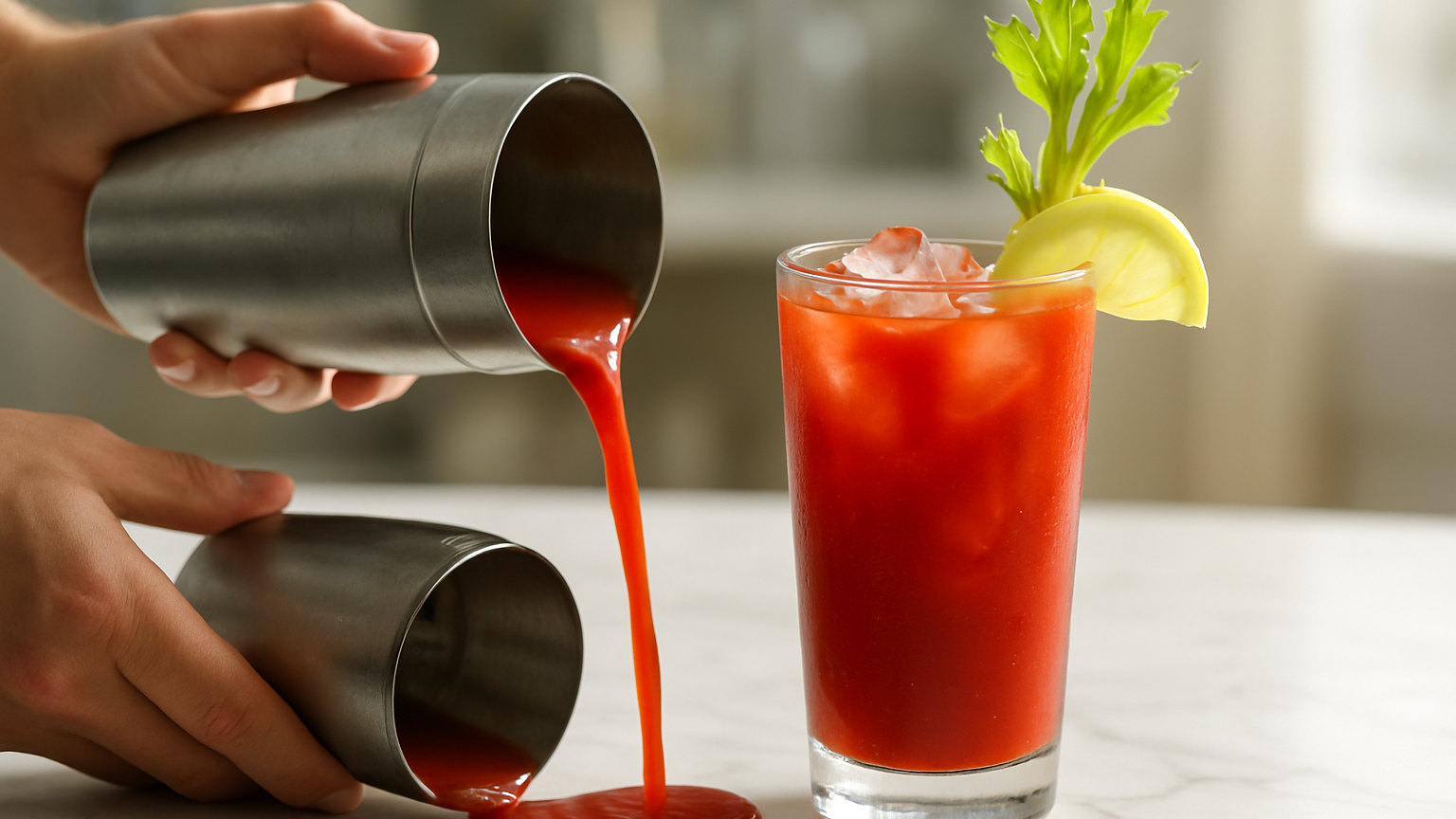
Rolling sits between shaking and stirring. The mixture is poured back and forth between two vessels several times, which combines and chills it while introducing far less air than shaking would.
Why it exists
Some ingredients are ruined by aeration.
Tomato juice is the clearest case. Shaking whips it into a pale frothy mess with an unpleasant texture, and the drink separates in the glass.
Rolling combines it thoroughly, chills it adequately and preserves the thick, smooth body that a bloody mary depends on.
The same applies to anything where texture is part of the point and foam is not.
The method
Combine the ingredients in one tin with ice.
Pour the whole contents, ice included, into a second tin from a modest height.
Pour it back. Repeat three or four times.
The falling liquid mixes as it goes and the ice chills it during transit and in the vessel.
Strain over fresh ice in the serving glass.
Getting it right
Height matters. Pouring from a few inches combines the mixture gently; pouring from higher introduces more air, which is a variable to control rather than to maximise.
Three or four passes is enough. More adds dilution without further mixing.
Keep the ice in during the transfers, since that is what does the chilling.
Use fresh ice in the serving glass rather than the ice you rolled with, which has already partially melted.
Which drinks suit it
Anything with tomato juice: bloody mary, red snapper, bloody maria.
Anything with a thick juice or a heavy texture that would suffer from foaming.
Some bartenders roll drinks containing a small amount of citrus where they want the combination without the cloudiness of a full shake.
Milk punch before clarification is sometimes rolled for the same reason.
The alternative
Building in the glass and stirring gently achieves a similar result with less equipment.
Combine everything in the serving glass over ice and stir with a bar spoon until combined and cold.
It is slightly less thorough and entirely adequate for a bloody mary made at home.
Throwing
The theatrical relative, associated with Spanish and Cuban bartending.
The drink is poured from one tin held high into another held low, in a long stream, sometimes several times.
The extended fall aerates the drink more than rolling does but less than shaking, and it also chills it while introducing very little ice fragmentation.
It is used for drinks where a light aeration is wanted without a full shake, and it is genuinely difficult to do without spilling.
A strainer held in the pouring tin catches the ice, so only the liquid travels.
Why it is worth knowing
Rolling is the technique most people have never heard of and the one that most improves a specific drink.
A bloody mary made by shaking is a noticeably worse drink than one made by rolling, and the difference costs nothing to achieve.
It also illustrates the general point that technique is an ingredient. The same components handled three different ways produce three different drinks, and choosing the right handling is as much a decision as choosing the spirit.
How cold it gets
Rolling chills less thoroughly than shaking, since the agitation is gentler and briefer.
For a bloody mary that is rarely a problem, since the drink is served over fresh ice and continues chilling in the glass.
Chilling the ingredients beforehand, particularly the tomato juice, makes a considerable difference and is worth doing if you are making several.
The name
Rolling is sometimes called the Cuban roll, reflecting where the technique is most associated, though variations appear in several bartending traditions.
Practising it
Try it with water first, since the transfer between tins takes a little practice and spilling a bloody mary across a worktop is a poor way to learn.
The pour should be steady rather than fast, and the receiving tin held slightly below the pouring one.


