
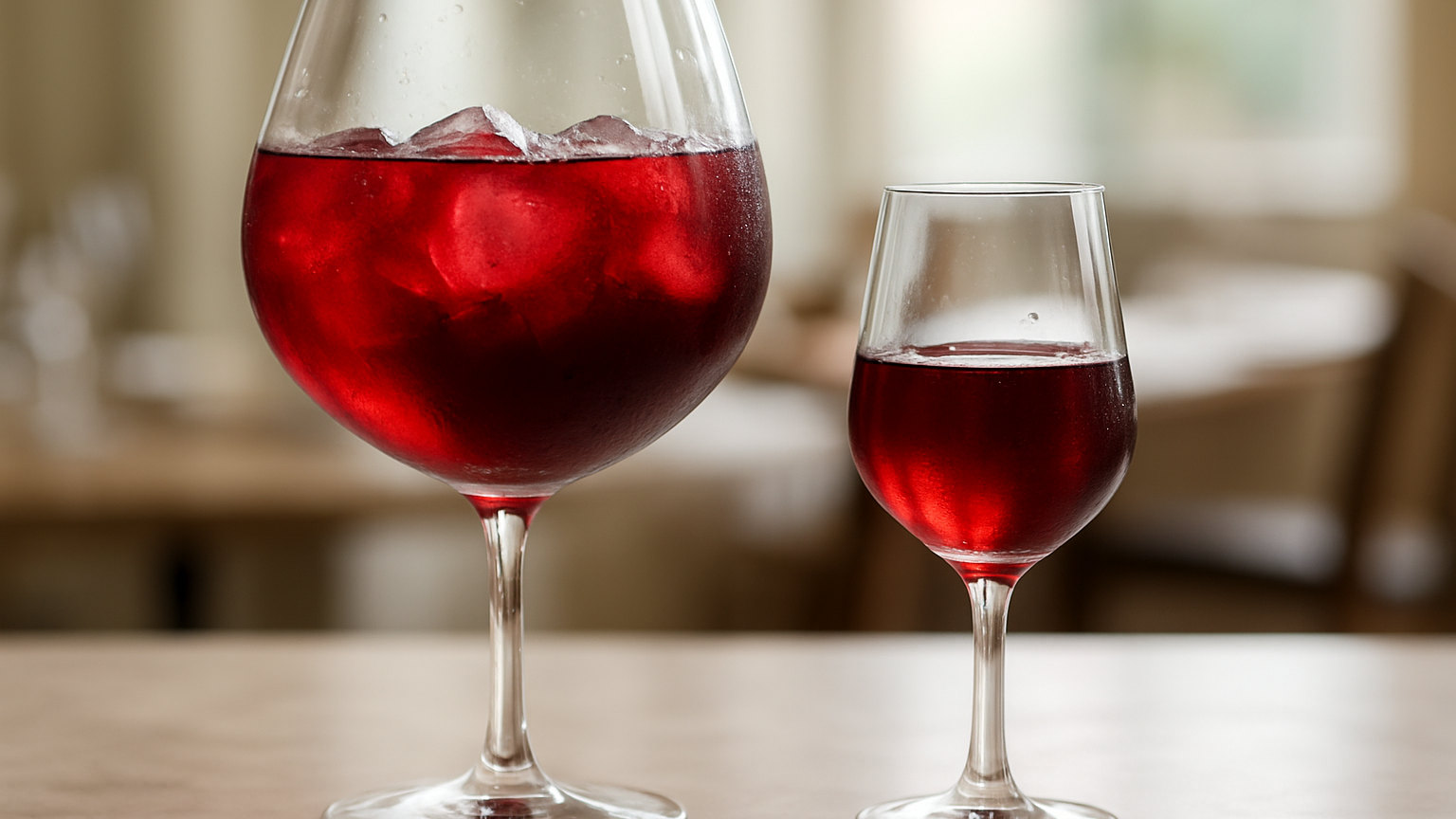
Wine glasses in Britain have grown substantially over the past few decades, from capacities of around 200 millilitres to ones commonly exceeding 400 and frequently reaching 600 or more.
Research into historical glassware has documented the change, and studies looking at consumption have found that glass size affects how much people pour and how quickly they drink it.
Why it happens
People judge quantity by how full a vessel looks rather than by volume.
A 175 millilitre pour in a 250 millilitre glass looks generous. The same pour in a 600 millilitre glass looks mean, which invites topping up.
The result is that a large glass produces a larger pour without anyone intending it, and the drinker's sense of having had two glasses is unchanged.
The same effect operates with plates and portion sizes, and it is well documented across food and drink generally.
The arithmetic
A standard bottle of wine is 750 millilitres.
At 125 millilitres a bottle gives six glasses. At 175 it gives just over four. At 250, which is what a large glass filled to the halfway mark holds, it gives three.
A 250 millilitre serving of wine at thirteen per cent contains around three and a quarter units, which is close to a quarter of the weekly guideline in one glass.
United Kingdom Chief Medical Officers advise not regularly exceeding fourteen units a week, spread over three or more days. How that applies to any individual is a matter for them and their doctor.
The same effect in cocktails
Martini glasses have grown in exactly the same way.
A martini made to a sensible recipe is around 115 millilitres after dilution. A modern V-shaped glass frequently holds 250 or more, in which that measure looks lost.
The response is a larger pour, and a 200 millilitre martini contains close to five units.
It will also be warm before it is finished, since a stirred drink contains no ice and warms steadily, which means the larger glass produces a worse drink as well as a stronger one.
What to do about it
Buy smaller glasses. A 150 millilitre stemmed glass for cocktails and a 400 to 450 millilitre wine glass are both sensible sizes, and both look properly filled at a reasonable measure.
Pour to a mark rather than by eye. Filling a wine glass to the widest point of the bowl is around a third full and close to 175 millilitres in most glasses, and it leaves the headspace the shape exists to create.
Measure once to calibrate. Pour 175 millilitres of water into your usual glass and note where it comes to, which takes thirty seconds and recalibrates your judgement permanently.
Use a measure for spirits at home, since a free-poured measure is almost always larger than a pub's 25 or 50 millilitres.
Why this is not fussiness
Most people are reasonably accurate about how many drinks they have had and considerably less accurate about how large those drinks were.
Someone reporting two glasses of wine may have had anywhere between 250 and 500 millilitres depending entirely on the glassware, which is a difference of several units.
Knowing the size of your own glasses is what makes the count meaningful.
The other advantage
Smaller glasses produce better drinks.
Wine warms less in a smaller pour and can be refreshed cold. A cocktail stays at temperature. A beer in a smaller measure is drunk while it is still lively.
The interests happen to align, which is convenient.
In a pub or restaurant
The same applies when you are not pouring. A large glass of wine in a restaurant is 250 millilitres, which is a third of a bottle and around three units.
Venues are required to offer a smaller measure and to make customers aware of it, though it is not always displayed prominently.
Asking for a small glass is entirely normal and frequently better value per unit as well.
The counter-argument
A large glass is not inherently a problem, since the headspace above the wine is what allows the aroma to collect.
The issue is the pour rather than the vessel, and a large glass filled to a sensible level is the ideal arrangement.
Which is why calibrating your own glasses once is more useful than replacing them.


