
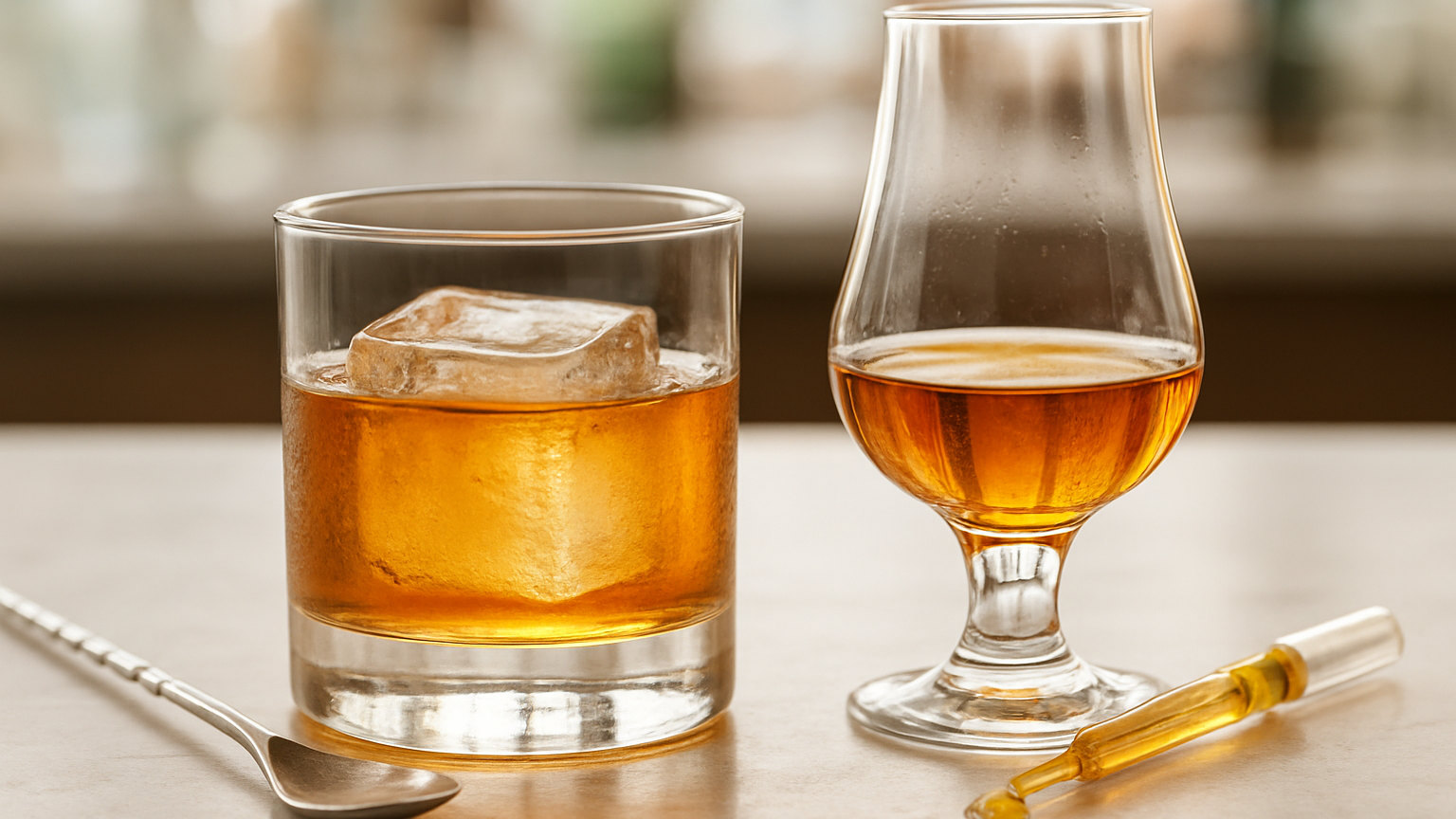
Whisky is drunk from a heavy cut-glass tumbler in every film ever made, and the tumbler is close to the worst shape for actually assessing what is in it. Both facts can be true at once.
The nosing glasses
The copita, borrowed from sherry, is a small tulip-shaped glass on a short stem. It was the industry standard for assessing whisky long before anything was designed specifically for it.
The Glencairn is the modern purpose-made version: a wide bowl narrowing to a tapered mouth on a solid base, designed in Scotland in the early 2000s and now widely used in distilleries and competitions.
Both work the same way. The wide bowl gives surface area for aromas to develop, and the narrow rim concentrates them and delivers them to the nose.
The difference from a tumbler is not subtle. The same whisky in both smells substantially more intense in the tapered glass.
Why the tumbler persists
It is pleasant to hold, it accommodates ice, it is stable, it does not look precious, and it suits a whisky being drunk rather than analysed.
A heavy base and a wide mouth also suit a large ice cube, which a nosing glass does not.
Nobody drinking a blend with soda on a Friday evening needs a Glencairn, and there is no reason to feel obliged to use one.
The alcohol problem
A narrow rim concentrates aroma and it also concentrates ethanol vapour, which can numb the nose at cask strength.
This is why a lid or a watch glass is sometimes placed over a nosing glass between assessments, and why the first sniff of a strong whisky should be taken from a distance with the mouth slightly open.
A wider glass disperses the ethanol more, which is one legitimate argument for the tumbler with high-strength spirits.
Water
Adding a small amount of water is not dilution in the sense of weakening. Lowering the alcohol content releases compounds that were bound up in the ethanol, and the aroma frequently opens up substantially.
A few drops is the usual starting point, added with a pipette or a spoon rather than poured.
Whether to add it is entirely a matter of preference. What is worth doing once is trying the same whisky before and after, since the change is often larger than expected.
Ice
Ice chills, which suppresses aroma, and dilutes as it melts.
For a whisky you want to assess, it works against you. For a whisky you want to drink on a warm evening, it is entirely reasonable.
A single large cube is far better than several small ones, since it melts more slowly and keeps the drink at its intended strength for longer.
Whisky stones do not work well. The cooling capacity of a solid is much lower than that of ice, which absorbs a great deal of heat as it melts, so a drink with stones in it is barely cooler.
What to own
If you taste whisky attentively, two Glencairns or copitas. They cost very little.
If you drink whisky casually, the rocks glasses you already own are fine.
Most people who take an interest end up with both, using the tapered glass for anything new or expensive and the tumbler for everything else.
Pour size
A nosing glass holds around 175 millilitres and is designed for a measure of 25 to 35.
Filling it further defeats the shape, since the headspace above the liquid is where the aroma collects, and it makes swirling impossible.
Other spirits
The same logic applies across the category. Brandy, rum, tequila and gin all show more in a tapered glass than in a tumbler.
The balloon brandy snifter is the exception that does not work well: the very wide bowl concentrates ethanol vapour uncomfortably, and a copita is a better vessel for cognac despite tradition.
Warming a snifter in the hand, which the shape invites, drives off aromatics rather than developing them.


