
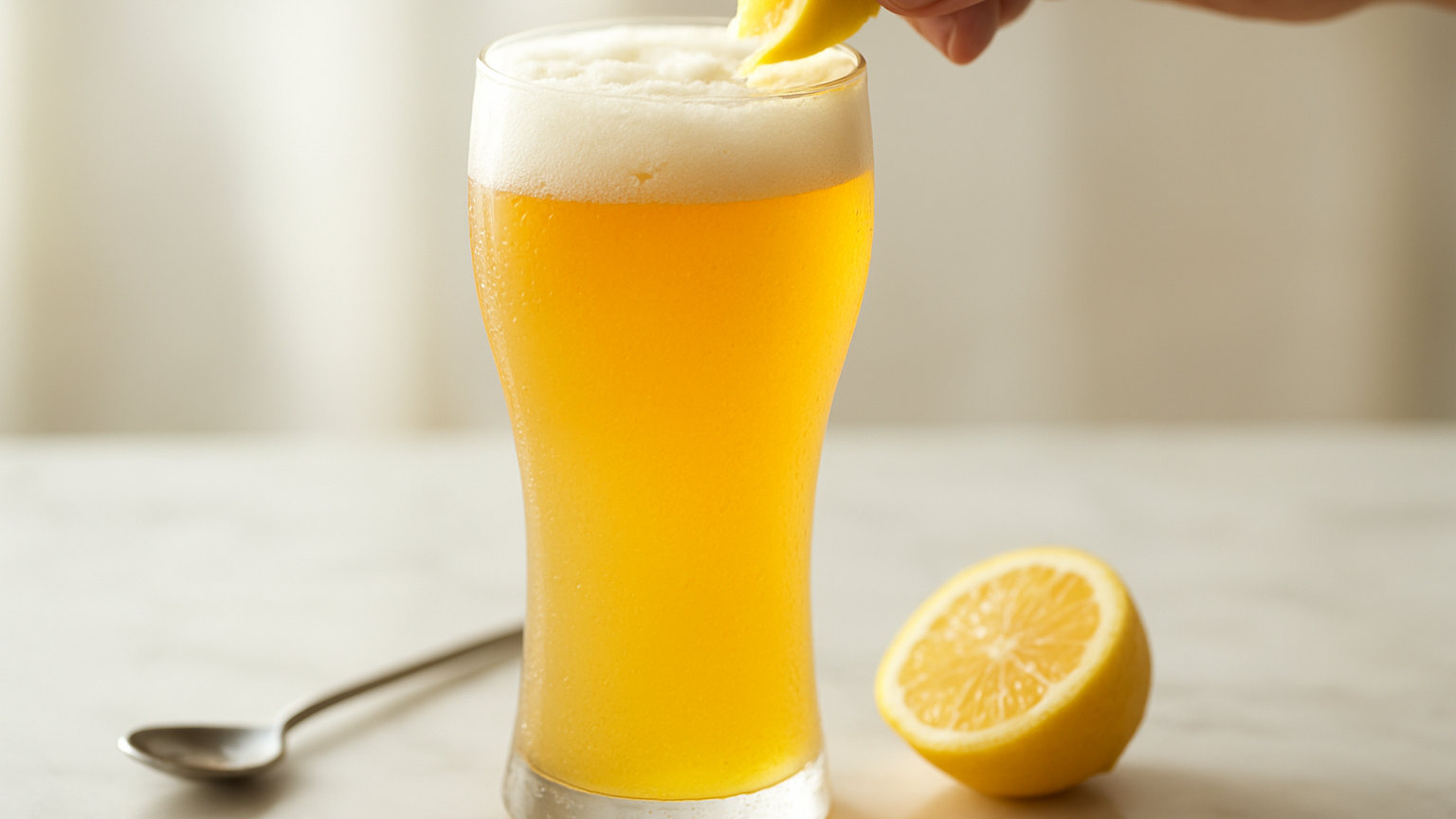
Order a wheat beer in a British or American bar and it frequently arrives with a wedge of lemon. Order one in Bavaria and it will not, and the objection is partly technical rather than purely cultural.
What fruit does to foam
Citrus oils and acid both destroy beer foam.
A wheat beer's dense white head is produced by the high protein content of the wheat, and squeezing lemon into the glass collapses it within seconds.
Any oil from the skin does the same thing, which is why a glass with the slightest trace of fat produces a flat-looking beer.
Since the head carries and releases aroma throughout the drink, losing it costs more than appearance.
The flavour objection
A German wheat beer is a yeast showcase, built around banana and clove aromas that are subtle and easily covered.
Lemon juice masks them, and what remains is a wheat beer tasting mainly of lemon.
Anyone who has only had it garnished has not really tasted the style.
Where the practice came from
It appears to have travelled with American wheat beers rather than German ones.
American wheat beer uses a clean-fermenting yeast, so it has none of the banana and clove character and the resulting beer is comparatively neutral.
A neutral wheat beer genuinely does benefit from a citrus lift, and adding lemon to it is a reasonable choice.
When the practice spread to imported German beers, the reasoning did not travel with it.
The Belgian exception
Witbier occupies different ground, since it is brewed with dried bitter orange peel and coriander.
An orange slice echoes an ingredient already present rather than introducing something foreign.
The head problem remains, and Belgian producers generally do not serve it garnished. But the flavour objection is much weaker, and a slice of orange with a witbier on a warm afternoon is a defensible thing to want.
Lime in lager
The other common case, associated with a particular Mexican brand and now widespread.
Explanations vary and none is well documented. What is clear is that it became a marketing convention and is now expected.
The effect is real: lime adds acidity and aroma to a beer that has little of either, which is either an improvement or a way of covering something up depending on your view.
For a mass market lager it is harmless and arguably an improvement. For a beer with character it is not.
Beers made with fruit
None of this applies where fruit is part of the recipe.
Belgian fruit lambics, fruited sours and modern fruit beers have had fruit added during production, frequently in large quantities and with months of maceration.
That is a brewing decision, and the fruit is integrated rather than sitting on top.
Adding more fruit to such a beer at the point of service would be as odd as adding hops to an IPA.
What to do
Taste the beer first and decide afterwards.
If you have never tried a German wheat beer without the lemon, you have not tried the style, and the banana and clove character is the thing worth encountering.
If you try it and prefer it with citrus, that is a legitimate preference and nobody should be lectured about it.
What is worth avoiding is the automatic garnish applied without asking. Requesting a wheat beer without the fruit is a normal thing to do.
The wider point
Beer has picked up several serving conventions that persist without much examination: lime in a bottle of lager, salt on a rim, fruit in wheat beer.
Most originated either with beers that needed the help or with bars looking for a point of difference.
Some are genuinely good and some are covering something up, and the way to find out which is to drink one glass as the brewer sent it before improving on it.
Asking for it without
Entirely normal and nobody will comment.
Most bars add the garnish automatically rather than as a considered decision, and saying you would rather have it plain takes a moment.


