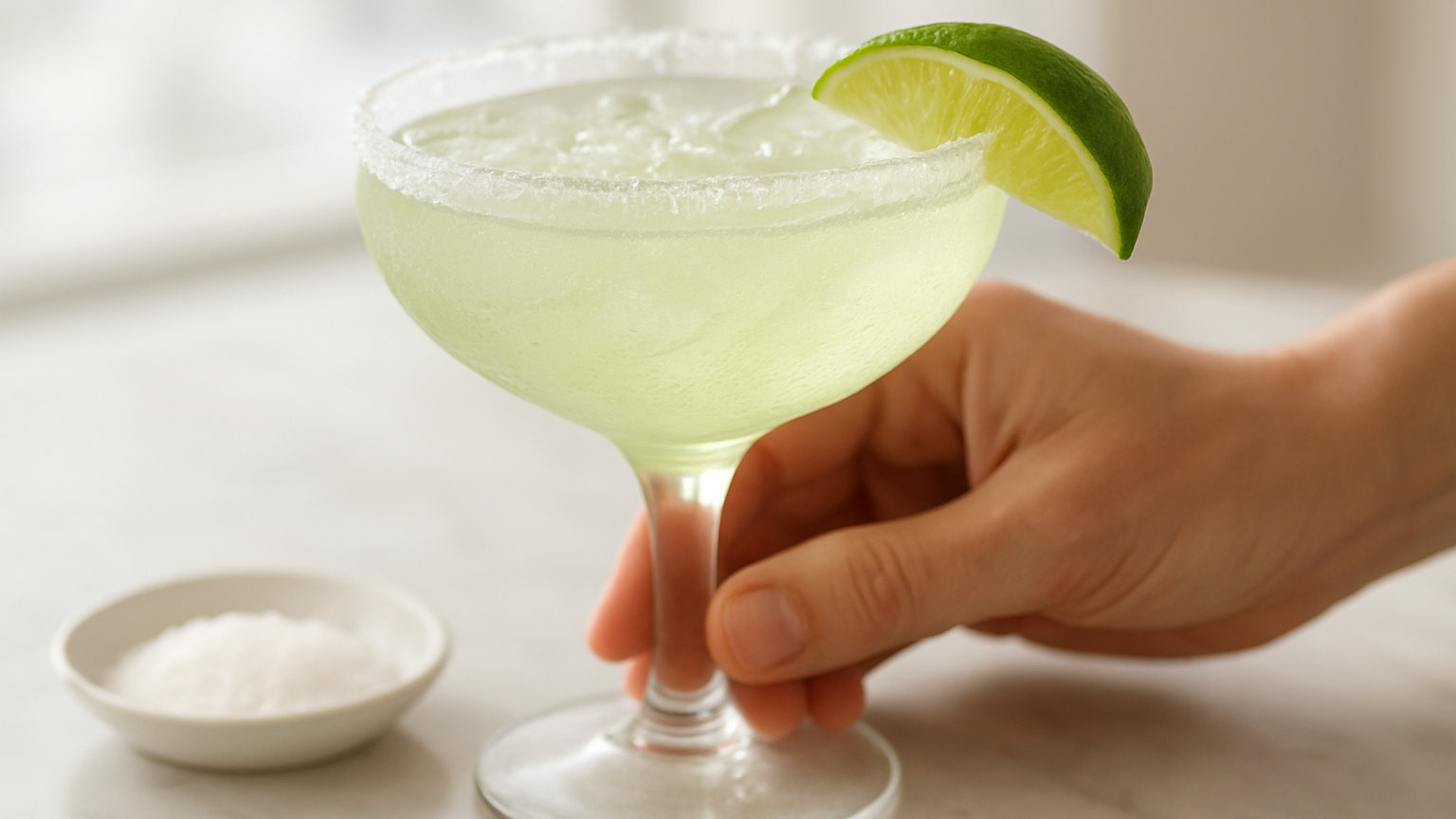
A salted rim changes every mouthful of a margarita, and it is done wrong routinely in a way that gets worse as the drink goes down.
The outside only
The single point that matters.
Coat the outside of the rim and the salt stays where it is. Coat the inside and it falls into the drink, which becomes progressively saltier with each sip.
A margarita made this way is pleasant at the start and unpleasantly salty by the end, and the drinker cannot do anything about it.
So the wetting agent goes on the outside of the rim, and the glass is rolled on its side rather than pressed down into the salt.
The method
Spread salt on a shallow plate rather than using a bowl, which coats too far down the glass.
Cut a wedge of lime and run it around the outside of the rim only, holding the glass at an angle.
Roll the outside edge of the rim across the salt, turning the glass. Do not press the mouth of the glass down into it.
Tap off any excess.
Chill the glass afterwards, or before if you are quick, since a chilled rim holds the coating better.
Half a rim
A courtesy worth extending, particularly when serving other people.
Coating only half lets the drinker choose whether to take salt with a given mouthful.
It matters for anyone limiting their salt intake, and it also suits people who like a little rather than a lot.
Nobody objects to being given the choice, and it takes no longer.
Which salt
Flaked sea salt is better than fine table salt, since it adheres in distinct crystals rather than forming a solid crust and it dissolves more gradually.
Coarse sea salt is too large and falls off.
Kosher salt, where available, has a good crystal size for the purpose.
Mixtures are common and worth trying: salt with chilli powder and dried lime is standard across Mexico, and salt with citrus zest or ground spice both work.
Sugar rims
The same technique with the same rules.
Caster sugar adheres well. Granulated is coarser and falls off more readily. Demerara looks better and dissolves more slowly.
The traditional use is on a sidecar, and it is worth thinking about rather than doing automatically, since a sidecar already contains a sweet liqueur and the rim adds more.
Half a rim is the sensible compromise there too.
The wetting agent
Citrus juice is traditional and works well.
Water holds less securely.
A wipe of syrup or liqueur holds sugar particularly well and adds a little sweetness at the rim, which suits a sugared glass better than juice does.
Whatever you use, keep it off the inside surface.
Other rim treatments
Ground spice, cocoa, crushed freeze-dried fruit and dried herbs all work as rims and adhere better with a syrup than with juice.
A chilli and salt mixture on a paloma or a michelada is genuinely good and standard practice in Mexico.
Anything gritty or hard should be avoided, since it is unpleasant against the lip.
Whether to do it at all
For a margarita or a paloma, salt does something real: it suppresses bitterness, amplifies the other flavours and makes the drink read as fuller.
For most other drinks it is decoration.
Asking for a drink without salt is entirely normal and nobody will comment, and offering the choice when serving is a small courtesy worth extending.
Practical points
Prepare rims before you make the drink, since doing it afterwards means handling a full glass.
Keep a plate of salt ready if you are making several.
And wipe the base of the glass afterwards, since salt on the outside ends up on the table.
Making a rim mix
Combining salt with dried citrus zest, chilli powder or ground spice takes a minute and keeps in a jar for months.
A common Mexican mixture is salt, chilli and dried lime, which is excellent on a paloma.
Grind anything coarse so the texture is even, since large fragments are unpleasant against the lip.