
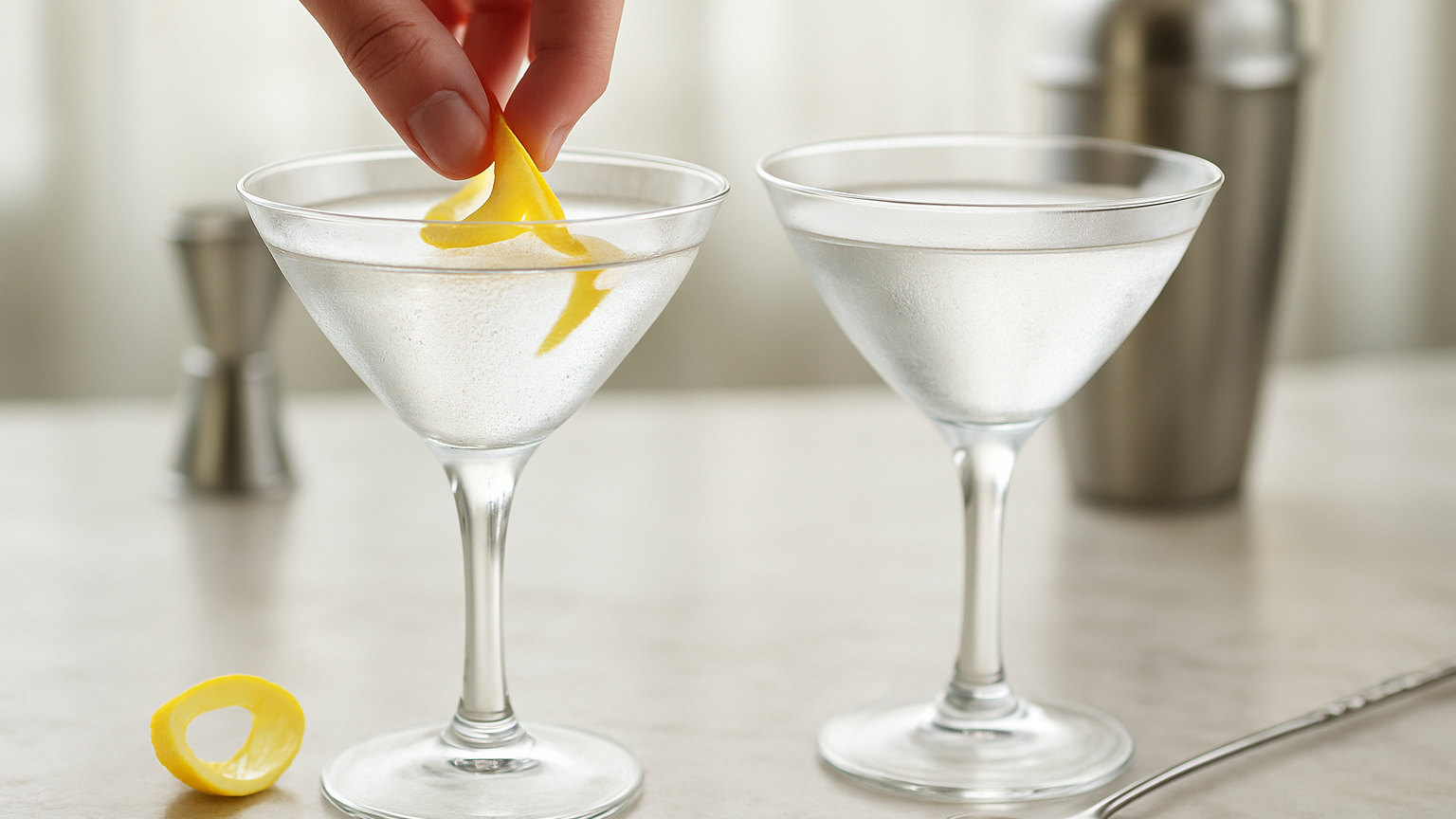
After a subcategory on garnishes, the question is worth putting directly: does any of it change how a drink tastes, or is it all presentation?
The answer is both, in different proportions depending on the garnish.
The physical effects
Real and demonstrable.
Citrus oil expressed over a drink lands on the surface and evaporates into the space beneath your nose. Since most of what we call flavour arrives through the nose, that is a direct sensory input.
Herb oils released by slapping do the same thing.
An olive contributes salt and brine to the liquid over the life of the drink.
A salted rim changes every mouthful directly.
A cherry is eaten, so it is a component rather than a decoration.
Bitters on a foam sit directly under the nose delivering aroma continuously.
All of these can be demonstrated by removing the garnish and comparing, and the differences are not subtle.
The expectation effects
Also real, and worth taking seriously rather than dismissing.
Research across food and drink consistently finds that appearance, description and context influence how people rate what they consume.
A drink that looks considered is enjoyed more than the same liquid served carelessly, and a drink described before it is tasted is experienced differently.
That is not a failure of the taster. It is how perception works, and the enjoyment is the outcome you were after.
Testing it yourself
The aroma effect is easy to isolate.
Make two identical drinks. Express a peel over one and not the other. Smell both before tasting either.
The difference is obvious and it is entirely aromatic, since the oil adds essentially nothing to the liquid.
The expectation effect is harder to test at home, since it requires not knowing which drink you have, which is difficult to arrange for yourself.
Which garnishes do which
Almost entirely physical: expressed citrus peel, slapped herbs, salt rims, olives, bitters on a foam, grated nutmeg.
Almost entirely expectation: edible flowers without scent, dried wheels perched on a rim, fruit fans, dusted patterns, anything visual.
Somewhere between: a citrus wedge that may or may not be squeezed, a dried wheel that sits in the drink, a cherry that may or may not be eaten.
Why the distinction matters
Because it tells you where to put the effort.
If you are making a drink for yourself on a weekday, the physical garnishes are the ones worth ten seconds and the visual ones are not.
If you are serving guests, both are worth doing, since presentation is part of hospitality and it genuinely affects how the evening goes.
Knowing which is which stops you either dismissing garnishes entirely or treating a fruit fan as though it were an ingredient.
The order of importance
For anyone deciding what to bother with.
Expressed citrus peel, which does the most for the least effort.
A clean, correctly sized, chilled glass, which is not a garnish and matters more than any of them.
A functional garnish matched to the drink.
Then presentation, when the occasion warrants it.
The honest conclusion
Garnishes change the taste of a drink in the specific sense that they change what reaches your nose, which is most of what taste is.
They also change how a drink is received, which is a different mechanism producing a similar outcome.
Neither is a reason to construct anything elaborate, and both are reasons to spend ten seconds on a peel rather than none.
Which is roughly where the subject deserves to sit: worth doing, not worth agonising over, and considerably less consequential than whether the glass is clean and the ice is fresh.
A final note
The most useful thing on this page is that a citrus peel must be squeezed over the drink to do anything.
Everything else is refinement. That one is the difference between a garnish and an ornament.
And if you take nothing else from the subcategory: cut the peel wide, squeeze it over the surface, rub it round the rim, and then decide whether to drop it in.


