
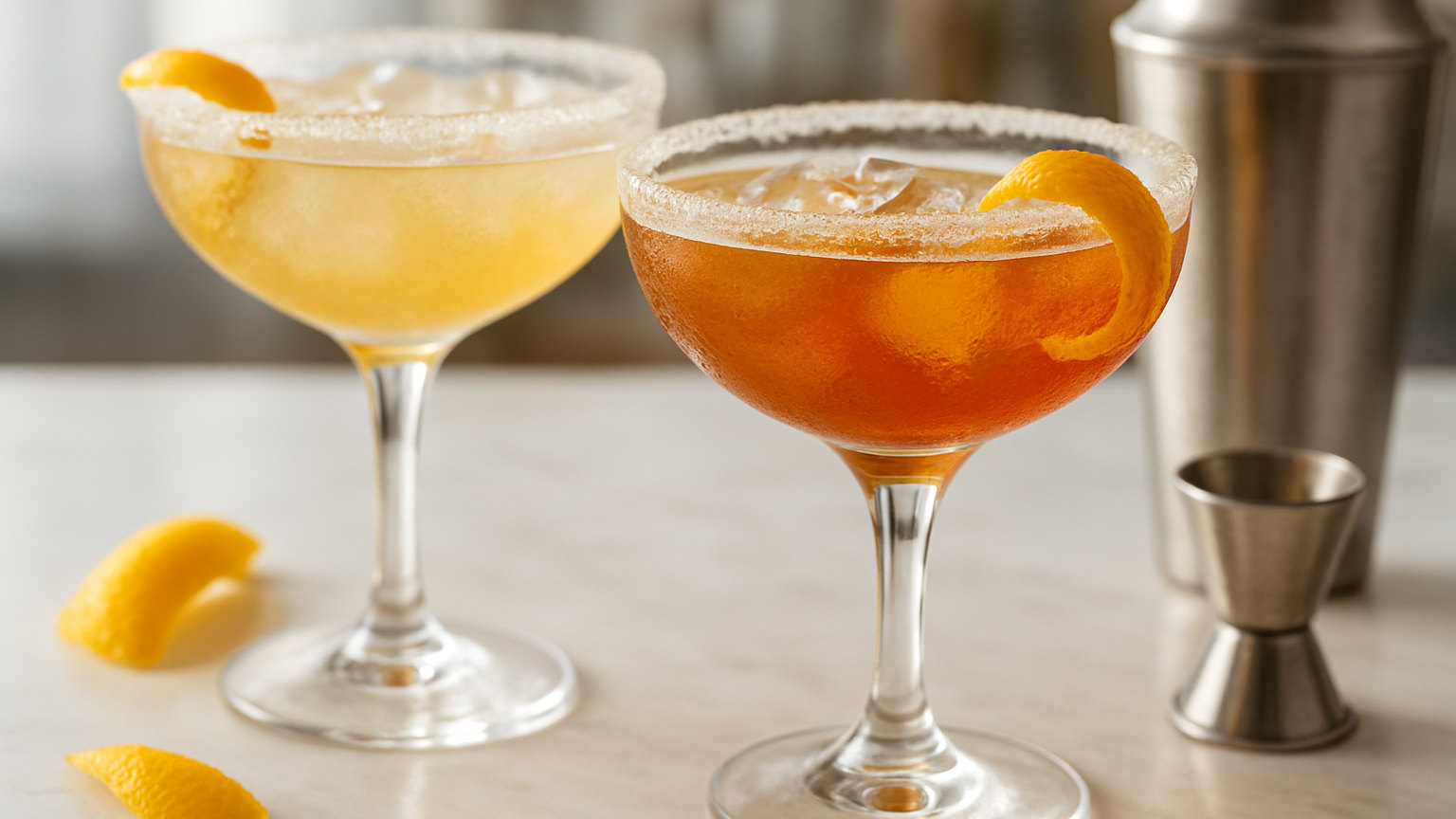
The sidecar is cognac, orange liqueur and lemon juice, shaken and served up. It is a straightforward sour and it generates more disagreement about proportions than almost any other classic.
The two schools
The English school, as recorded in the Savoy Cocktail Book, uses equal parts: one third cognac, one third orange liqueur, one third lemon juice.
The French school uses two parts cognac to one part each of liqueur and lemon.
The difference is substantial. The equal parts version is sweet, citrus-forward and liqueur-dominated. The French version is spirit-forward and considerably drier.
Most modern bars use something closer to the French approach or a compromise between the two, and the standard sour ratio works well: 50 millilitres of cognac, 25 of orange liqueur and 20 of lemon juice.
Neither is wrong. It is worth making both, since the comparison demonstrates how much a ratio changes a drink built from identical bottles.
The origin
The usual accounts place it in Paris or London around the end of the First World War, with a story about an army officer arriving at a bar in a motorcycle sidecar.
Two establishments have historically claimed it and the documentary evidence for either is thin, which is the normal state of affairs for cocktails of this period.
What is clear is that it appears in print in the early 1920s and had become a standard within a decade.
The brandy
Cognac is traditional. A VSOP has enough age and body to stand up to the liqueur and the lemon; a VS is thinner but perfectly serviceable.
Armagnac gives a rustic, more assertive version with more grip.
Calvados makes an apple-driven variation that is excellent in autumn.
American brandy and Spanish brandy both work and give different results, the latter noticeably sweeter.
What matters more than the region is that the brandy has some character, since a neutral one leaves the drink tasting of liqueur and lemon.
The liqueur
The orange liqueur is doing two jobs, providing sweetness and flavour, so a poor one damages the drink twice.
Cheap triple sec is sweetened orange flavouring and produces a sugary result. A proper curaçao or a cognac-based orange liqueur brings genuine bitter orange character.
Since there is no separate sweetener in the recipe, the liqueur's sugar content determines the drink's sweetness, which is part of why the ratio arguments persist: different liqueurs need different proportions.
The sugared rim
Traditional and optional, and worth thinking about rather than doing automatically.
The argument for it is that a sidecar with a lemon-forward ratio is sharp, and the sugar provides relief at the lip.
The argument against is that it adds sweetness to a drink that already contains a sweet liqueur, and it makes the drink progressively sweeter as you go.
If you use one, sugar only half the rim so the drinker can choose, and apply it to the outside of the glass only.
The variations
Replace the cognac with bourbon and you have a drink sometimes called a derby or a bourbon sidecar.
Replace it with rum and the structure holds perfectly well.
Add a dash of aromatic or orange bitters, which is not traditional and adds a useful complexity.
A version with a small measure of amaro in place of some of the liqueur is drier and more interesting, and it is a good demonstration of how flexible the sour template is.
Making it well
Fresh lemon, squeezed to order.
Shake hard and double strain, since the drink is served up and should be clean.
Chill the glass thoroughly beforehand.
And taste before straining. With three ingredients and no separate sweetener, the balance depends entirely on the particular liqueur and the particular lemon, and adjusting by a few millilitres is part of making the drink.
Where it sits now
The sidecar spent decades as an unfashionable drink, associated with an older generation and with brandy's general decline in favour.
Its return has come alongside renewed interest in cognac and in pre-war recipes, and it is now a standard on serious lists. It remains a useful drink to order in an unfamiliar bar, since a good one requires fresh citrus, a decent liqueur and a properly balanced ratio, and a bad one reveals all three problems at once.


