
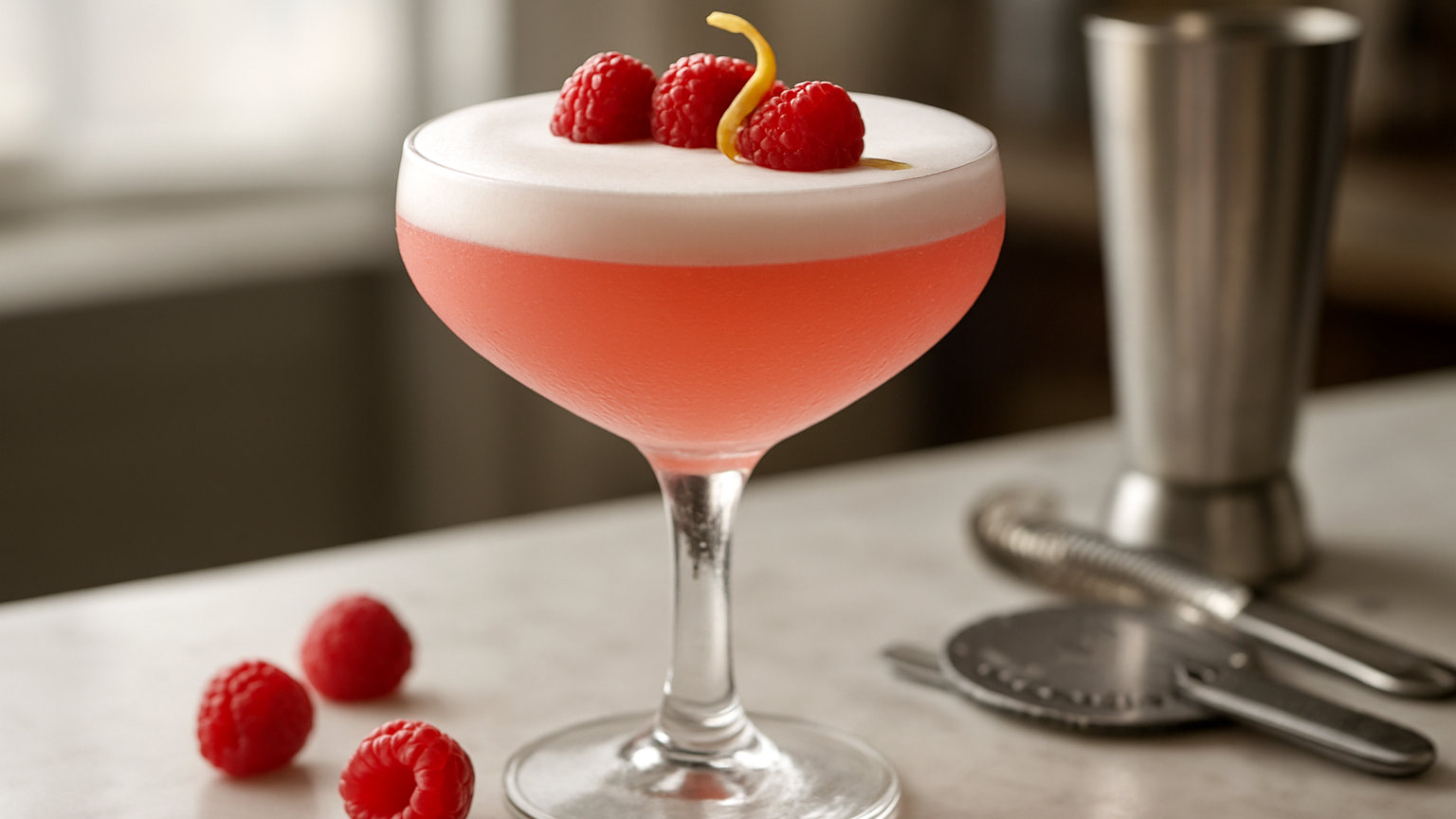
The clover club is gin, lemon, raspberry syrup and egg white, shaken to a foam and served up. It was a fixture of American bars before Prohibition, named after a Philadelphia gentlemen's club, and it spent most of the twentieth century as a punchline.
The recipe
Combine 50 millilitres of gin, 20 millilitres of fresh lemon juice, 20 millilitres of raspberry syrup and one egg white.
Some recipes include 15 millilitres of dry vermouth, which adds a herbal dryness and is worth trying.
Dry shake without ice for fifteen seconds, then add ice and shake again for twelve.
Double strain into a chilled coupe and garnish with a raspberry or two.
The raspberry syrup
This is what separates a good clover club from a sweet pink drink, and it takes ten minutes.
Combine 200 grams of raspberries, fresh or frozen, with 200 grams of sugar and 100 millilitres of water. Warm gently until the sugar dissolves and the fruit breaks down, then leave to infuse for twenty minutes.
Strain through a fine sieve, pressing gently, and refrigerate. It keeps for a couple of weeks.
Grenadine is sometimes substituted and should not be. Proper grenadine is pomegranate, and the commercial version is generally sweetened red syrup with no fruit in it at all.
Fresh raspberries muddled in the shaker also work, and need fine straining.
Why it fell out of favour
Two reasons, and neither reflects on the drink.
The first is Prohibition, which broke the continuity of American bartending. Drinks that depended on fresh syrups and careful technique did not survive well in a period of poor spirits and improvised bars.
The second is that it is pink and frothy, and for a long stretch of the twentieth century that was enough to make a drink unfashionable and to attach assumptions to whoever ordered it.
The result was that a well constructed gin sour with real fruit acquired a reputation as something unserious, which had nothing to do with what was in the glass.
The revival
Its return came with the wider cocktail revival, and the drink is now a standard on serious lists.
The rehabilitation was helped by bartenders pointing out that the assumptions attached to it were about colour rather than construction, and that a drink dismissed for being pink is being judged on something irrelevant.
Made properly with real raspberry syrup and a good gin, it is dry, structured and considerably less sweet than its appearance suggests.
Egg white and alternatives
Pasteurised egg white performs identically and removes any safety concern, and aquafaba works as a vegan substitute in the same quantity.
Anyone pregnant, elderly, very young or with a compromised immune system is generally advised to avoid raw egg.
Say what is in the drink when serving it, since egg is a declarable allergen.
Related drinks
A pink lady is gin, apple brandy, lemon, grenadine and egg white, and suffered the same reputational fate for the same reasons.
A bramble uses gin, lemon and blackberry liqueur over crushed ice, and is the modern British relative.
A raspberry gin sour without the egg is simpler and perfectly good.
The broader point is that a good many pre-Prohibition drinks are excellent and were abandoned for reasons of fashion rather than quality, and working through an old bar book turns up several worth reviving.
The vermouth question
Whether to include dry vermouth divides recipes, and both versions appear in period sources.
With it, the drink is drier, more herbal and more complex, and the vermouth's botanical character sits well against the gin.
Without it, the raspberry and lemon are more prominent and the drink is simpler and fruitier.
If you include it, keep the vermouth in the fridge and use it within a month or two, since it is wine and a stale bottle will spoil the drink entirely.
The gin
A juniper-forward London dry is the right choice, since the drink needs the gin to assert itself against the fruit and the sugar.
A soft contemporary gin tends to disappear, leaving something that tastes mainly of raspberry. If the drink seems one-dimensional, the gin is usually the reason rather than the syrup.


