
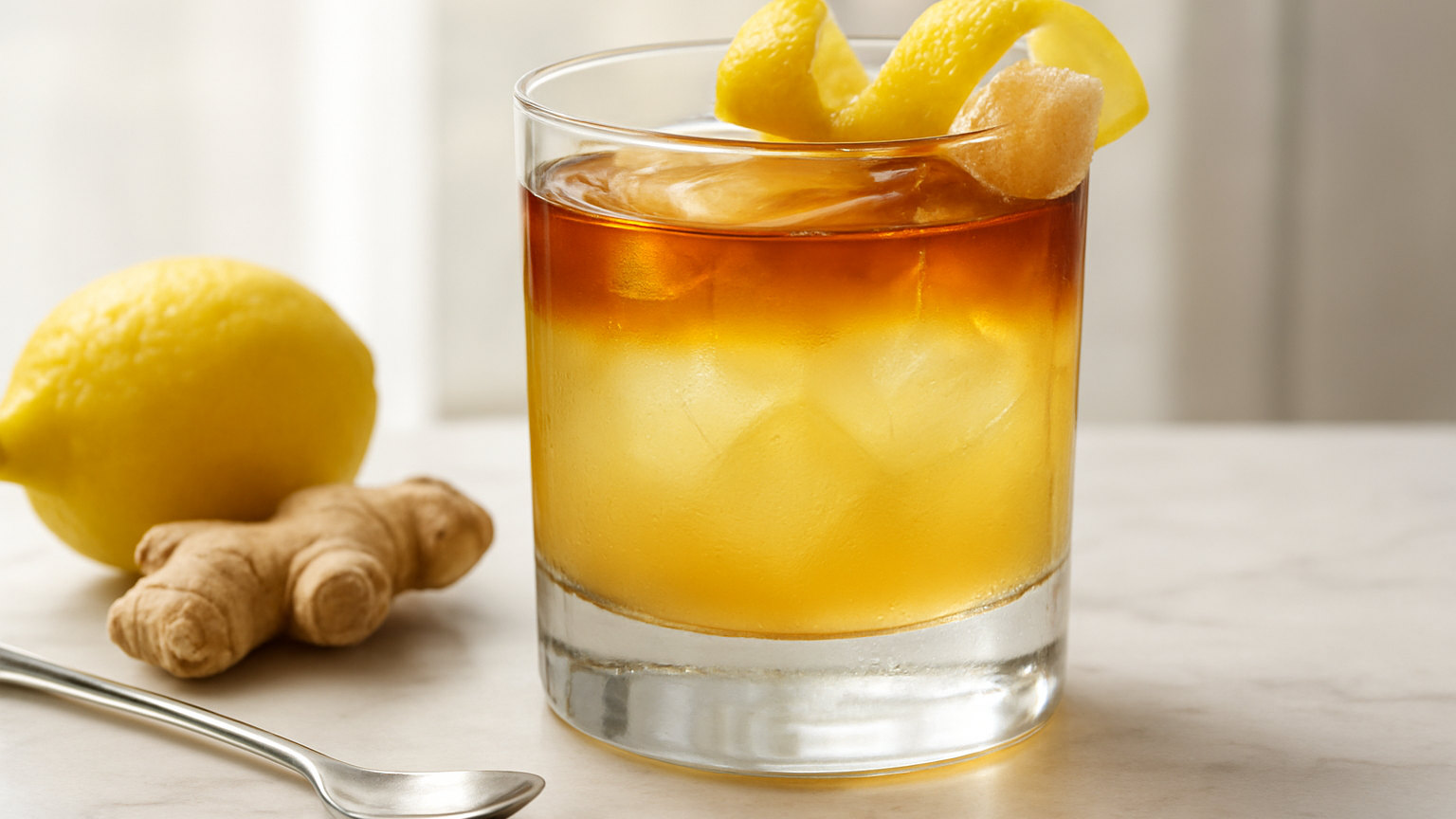
The penicillin is the most successful cocktail invented this century. Created by Sam Ross in New York in the mid 2000s, it is now made in bars worldwide and has done more than anything else to convince people that Scotch belongs in cocktails.
The recipe
Combine 60 millilitres of blended Scotch, two ounces, with 22 millilitres of fresh lemon juice and 22 millilitres of honey-ginger syrup, three quarters of an ounce of each.
Shake hard with ice and strain over a large cube in a rocks glass.
Float 7 to 10 millilitres of a peated Islay single malt on top by pouring it gently over the back of a bar spoon.
Garnish with a piece of candied ginger if you have it.
The syrup
The honey-ginger syrup does most of the work and takes ten minutes.
Combine equal weights of honey and water in a pan with a generous quantity of fresh ginger, peeled and sliced thinly. Warm gently without boiling, stir until the honey dissolves, then leave to infuse for half an hour.
Strain and refrigerate. It keeps for a couple of weeks and is worth making in a decent quantity, since it is useful in tea and in cooking as well.
The ratio of ginger is a matter of taste, and more is generally better than less. The drink should have a definite ginger heat.
Why the float works
This is the idea the drink is built on and it is worth understanding, since it applies elsewhere.
A heavily peated whisky mixed into the drink would dominate everything. Floated on top, it sits above the surface, so the smoke reaches the nose with every sip while the body of the drink remains a balanced honey and ginger sour.
The effect changes as you drink, since the float gradually integrates, and the last third of the glass is smokier than the first.
It is the same principle as an absinthe rinse: where an ingredient is too assertive to measure, deliver it aromatically rather than in the liquid.
Which whiskies
The base should be a decent blended Scotch, and this is one of the better arguments for blends. Something smooth with a little sweetness works; an expensive single malt is wasted and frequently too assertive.
The float should be recognisably peated. Any of the smokier Islay malts will do, and a small bottle lasts a long time given the quantity used.
Substituting a peated malt for the whole base produces a different and much heavier drink, which some people prefer and which is not the same thing.
Variations
The template travels. The same structure with mezcal in place of the float, or with an aged rum base, works well.
Replacing the honey with a different syrup changes the character considerably, and a demerara version is drier and less floral.
A version served long over crushed ice with soda is refreshing and considerably lower in strength, which is a reasonable adaptation for a warm afternoon.
Why it succeeded
It solved a problem. Scotch was regarded as difficult in cocktails, and the penicillin gave bartenders a drink that showcased it without asking drinkers to appreciate smoke unaided.
It also has a memorable idea at its centre, which the espresso martini's foam and the bramble's drizzle also have. A drink people can describe in one sentence spreads faster than one they cannot.
And the name helps, which is not a trivial observation. A good deal of what determines whether a drink survives is whether people enjoy ordering it.
A note on the name
The drink is named for the idea that whisky, honey, lemon and ginger are the traditional components of a hot toddy taken when unwell, which is the joke.
It is worth saying plainly that it is a joke rather than a claim. A hot toddy is a comforting drink and alcohol does not treat a cold, and current advice is that alcohol can interfere with sleep and with some medicines. Anyone genuinely unwell is better served by the honey, lemon and ginger without the whisky, and by their pharmacist if it persists.


