
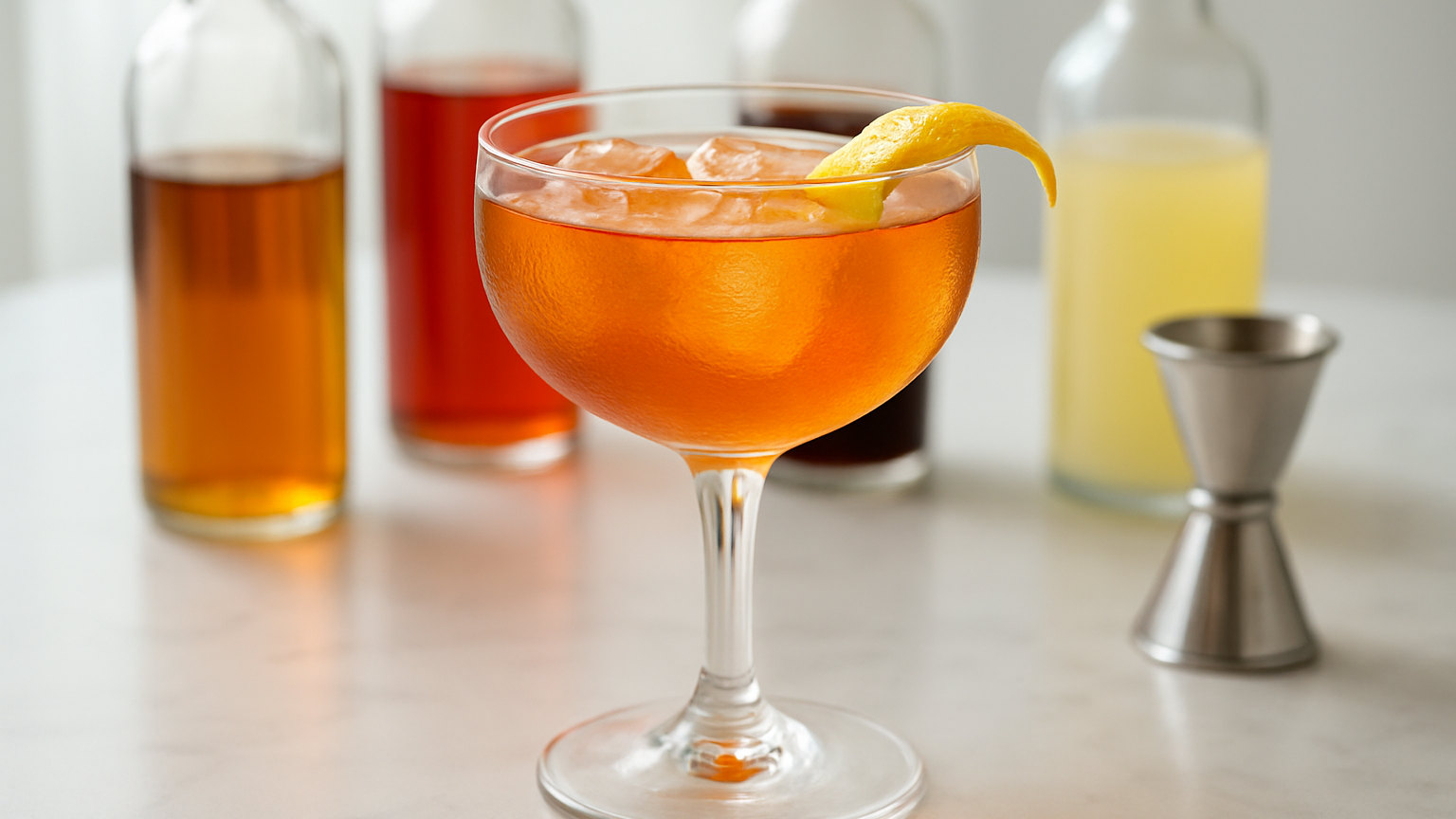
The paper plane is bourbon, an Italian amaro, a bitter aperitivo and lemon juice in equal measures. It was created by Sam Ross in the late 2000s, named after a song, and it has become one of the most reliably ordered modern drinks.
The recipe
Combine 22 millilitres each of bourbon, Amaro Nonino, Aperol and fresh lemon juice, three quarters of an ounce of each.
Shake hard with plenty of ice and strain into a chilled coupe.
No garnish is traditional, though a lemon twist does no harm.
That is the entire drink, and the fact that it can be written in one line is a substantial part of why it spread.
Why the ratio works
Equal parts drinks only function when every component is assertive, and this one has an unusually clean division of labour.
Bourbon supplies the strength, sweetness and body. The amaro supplies herbal bitterness and depth. The aperitivo supplies a lighter, more orange-driven bitterness and colour. Lemon supplies acid.
Two bitter components sounds like too many and works because they are different kinds of bitter: one dark and herbal, one bright and citrus-led. They sit at different points rather than competing.
The lemon then lifts everything, which is what stops the drink being heavy.
The amaro question
Amaro Nonino is specified in the original and is worth buying if you intend to make the drink regularly. It is a grappa-based amaro, lighter and more orange-forward than most, and the drink was built around its particular character.
Substitutions work with adjustment. A darker, more medicinal amaro produces a heavier drink and may need slightly less. A lighter one may need slightly more.
This is a general point about amaro in cocktails: the category covers an enormous range from gentle and orangey to aggressively bitter and menthol-driven, so a recipe calling for amaro without specifying which is nearly useless.
Where it came from
The drink is a deliberate variation on the last word, which is equal parts gin, green chartreuse, maraschino and lime.
Ross substituted an American spirit, two Italian bitters and lemon, keeping the structure exactly. Several other modern drinks were arrived at the same way, including the naked and famous, which applies the same treatment using mezcal and yellow chartreuse.
This is worth noticing as a method rather than as trivia. Taking a proven structure and substituting components systematically is how a considerable proportion of good modern drinks were created.
Adjusting it
Increasing the bourbon to 30 millilitres while keeping the others at 22 produces a stronger, drier drink and is a common house variation.
Rye in place of bourbon gives more spice and less sweetness, which suits people who find the original slightly rich.
Replacing the aperitivo with a more bitter red equivalent shifts the drink considerably and produces something closer in weight to a whiskey negroni with lemon in it.
Making it well
Fresh lemon, squeezed to order, since the drink is a quarter citrus.
Shake hard and double strain, since the finished drink should be clean rather than carrying ice shards.
Chill the glass properly. There is no ice in the served drink, so it will warm quickly in a room-temperature coupe.
And note the strength. Ninety millilitres of ingredients, three of them alcoholic, produces a drink of roughly two units in a small glass that is extremely easy to drink quickly, which is a fair description of most well made equal parts cocktails.
Where the name came from
Ross named it after a song, which is a common enough origin in this period. The naming conventions of the cocktail revival lean heavily on music, literature and private jokes rather than on describing the drink.
That is worth knowing when reading a list, since a name tells you nothing about what is in the glass. Asking is entirely reasonable, and a bar that cannot describe a drink in one sentence has usually overcomplicated it.


