
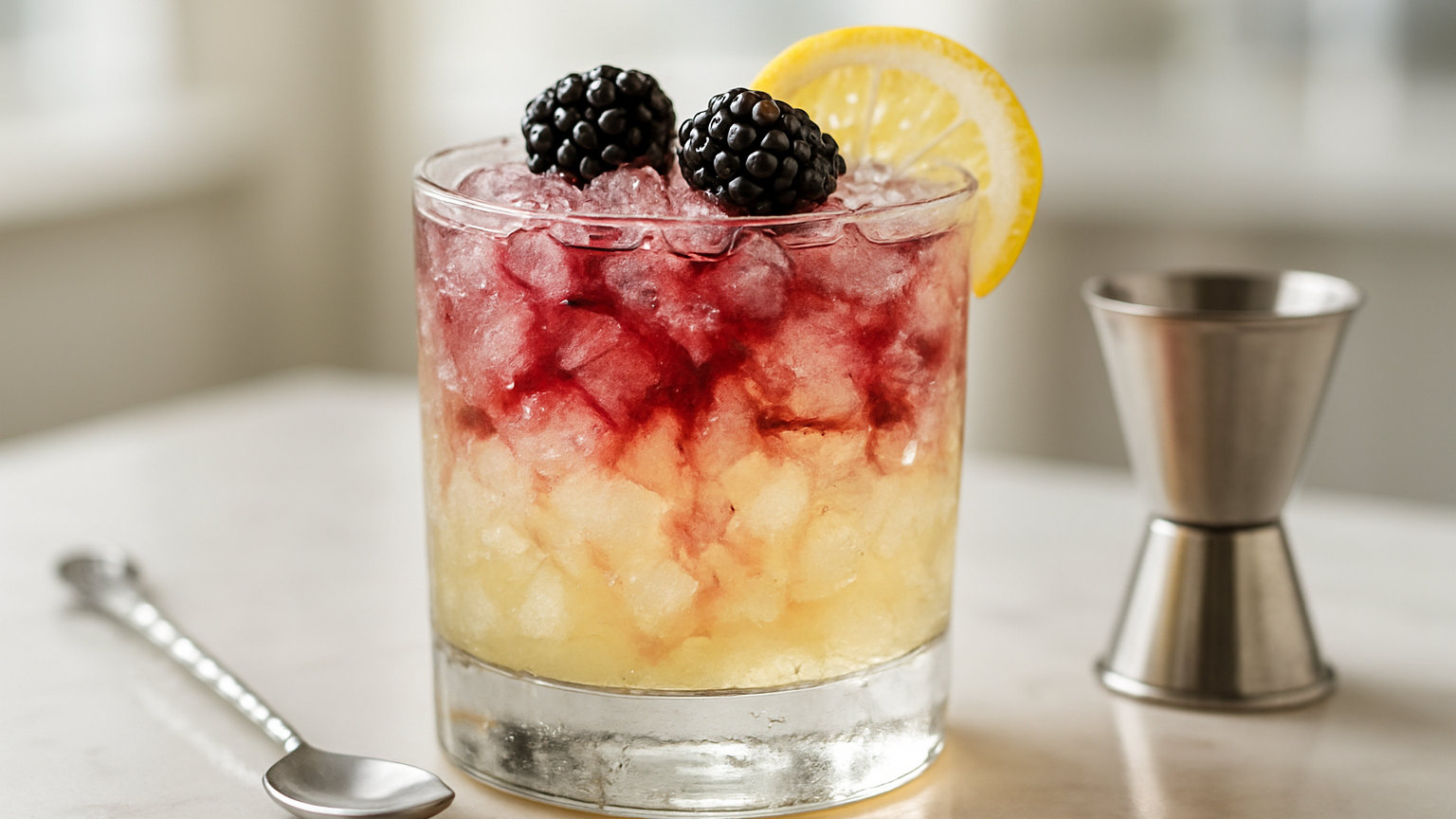
The bramble is a gin sour served over crushed ice with blackberry liqueur drizzled over the top so it bleeds down through the drink. It was created by Dick Bradsell in London in the 1980s and is among the few British contributions to the modern canon.
The recipe
Combine 50 millilitres of gin with 25 millilitres of fresh lemon juice and 12 millilitres of sugar syrup, roughly two ounces, three quarters of an ounce and half an ounce.
Shake briefly with ice and strain into a rocks glass filled with crushed ice.
Drizzle 15 millilitres of crème de mûre, blackberry liqueur, over the top so it sinks in streaks through the ice.
Garnish with a blackberry and a lemon slice.
Why the liqueur goes on top
Mixing the blackberry liqueur into the drink would produce a uniformly sweet purple sour, which is pleasant and considerably less interesting.
Drizzled over crushed ice, it descends slowly, so the drink changes as you work down the glass: sharp and gin-forward at the top, progressively sweeter and fruitier towards the bottom.
It also looks striking, which is not a trivial consideration for a drink that spread through bars.
The technique is worth stealing. Any sour served over crushed ice can take a liqueur float, and the same shifting effect follows.
The crushed ice
Not optional. The drink depends on ice that packs densely enough to hold the liqueur in suspension as it filters down, which cubes cannot do.
Crushed ice also dilutes continuously, so the bramble starts strong and becomes longer and more refreshing, in the same way a julep does.
Crushing it at home is straightforward: wrap cubes in a clean tea towel and hit them with a rolling pin.
The origin
Bradsell created it at a bar in Soho, and the usual account has him thinking about blackberrying in Kent as a child, which is a more English origin story than the cocktail world generally produces.
He is also responsible for the espresso martini and several other drinks of the period, and his influence on London bartending in the 1980s and 1990s is difficult to overstate. A striking proportion of British modern classics trace back to him.
The liqueur
Crème de mûre is blackberry liqueur and is the correct ingredient. Crème de cassis, made from blackcurrant, is more widely stocked and produces a recognisably different drink that is still good.
The word crème in this context indicates a high sugar content rather than any dairy, which occasionally confuses people.
An open bottle keeps reasonably well and is worth refrigerating, since these liqueurs dull over time.
Variations
The structure is a gin sour, so the substitutions are obvious. Different fruit liqueurs work directly, and a raspberry or damson version behaves the same way.
Replacing the gin with vodka produces something lighter and less interesting; with sloe gin, something considerably sweeter that needs less liqueur.
A version made with fresh blackberries muddled in the shaker is excellent in late summer, though it needs fine straining and the liqueur drizzle still does the visual work.
Getting it right
Fresh lemon, and taste before serving, since the syrup quantity depends on how sweet the liqueur is.
Shake briefly rather than hard, since the crushed ice will provide further dilution and an over-shaken base makes the finished drink watery.
And drizzle slowly. Pouring the liqueur in one go sends it straight to the bottom, which loses the effect the drink was designed around.
Bradsell's wider influence
It is worth noting how much of the British modern repertoire came from one person working in a handful of London bars.
Alongside the bramble and the espresso martini, several other drinks in general circulation trace to him, and a generation of British bartenders trained in his bars.
The pattern matches what happened in New York twenty years later: a small number of venues taking ingredients and technique seriously at a time when almost nobody else did, and the drinks spreading outwards as their staff moved on.


