
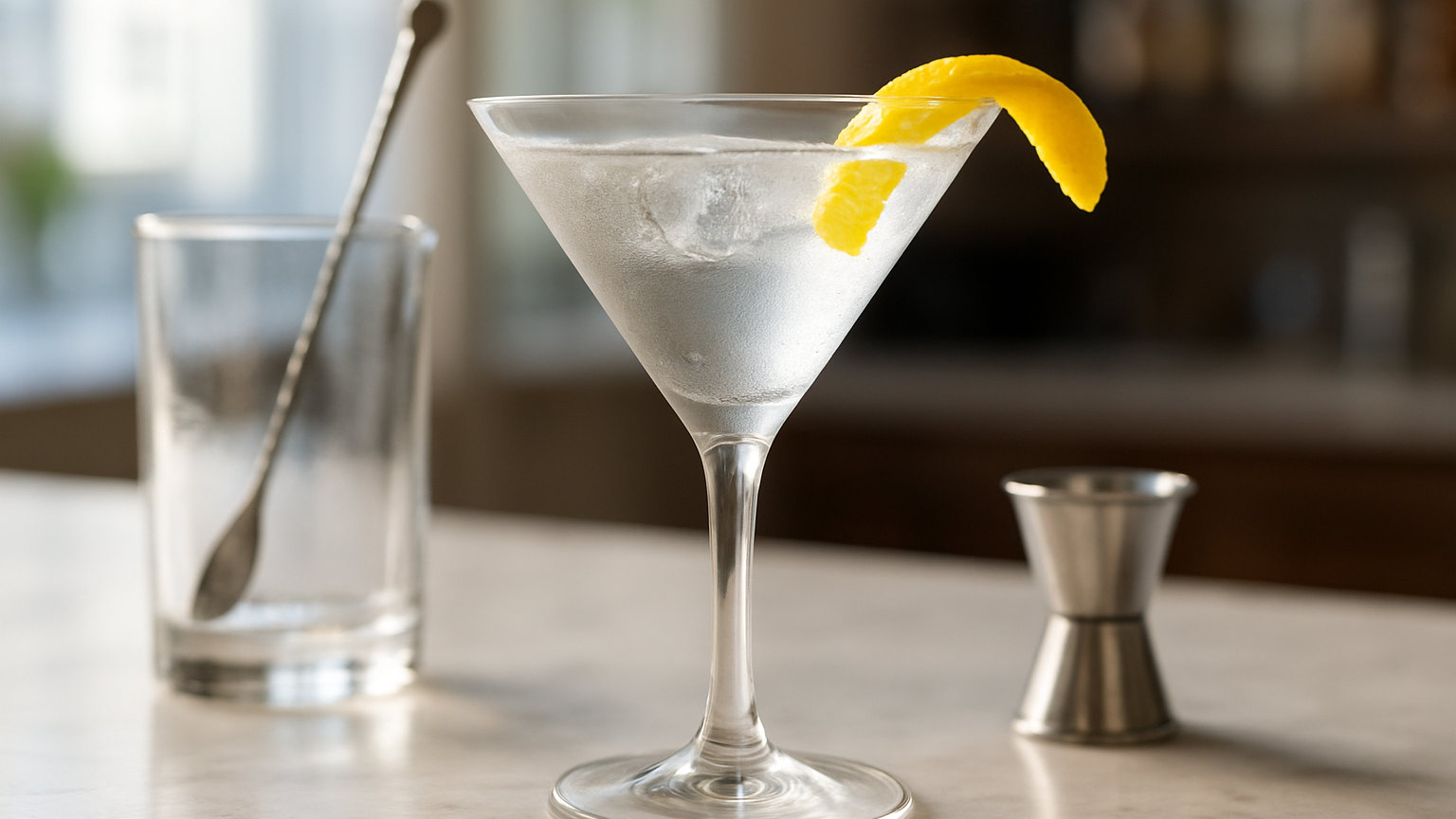
Stirred cocktails contain no juice, no soda and no mixer. Everything in the glass is alcoholic, which makes them the strongest category of drink on any list by a considerable margin.
The arithmetic
A unit of alcohol is ten millilitres of pure ethanol. A single 25 millilitre measure of a spirit at forty per cent contains one unit.
A martini made with 60 millilitres of gin at forty per cent and 20 millilitres of vermouth at eighteen contains around two point eight units.
A manhattan with 60 millilitres of rye at forty five per cent and 30 of vermouth contains around three units.
A negroni with 30 millilitres each of gin at forty, aperitivo at twenty five and vermouth at sixteen contains around two and a half units.
For comparison, a 175 millilitre glass of wine at thirteen per cent contains around two point three units, and a pint of four per cent beer contains around two point three.
Two martinis therefore sit somewhere close to five and a half units, which is a substantial evening's drinking in two small glasses.
Why they feel deceptive
Several things conspire.
The glasses are small, and volume is what people instinctively use to estimate quantity.
They are served very cold, which suppresses the perception of alcohol.
A well made one is balanced and smooth, so nothing about it announces its strength.
And they are drunk relatively quickly, since they warm.
The result is that two stirred cocktails can arrive considerably faster than the equivalent in wine or beer, with the same alcohol.
The guidance
United Kingdom Chief Medical Officers advise that both men and women should not regularly drink more than fourteen units a week, spread over three or more days, with several drink-free days.
The guidance states that there is no level of regular drinking that carries no risk.
How that applies to any individual is a matter for them and their doctor. The arithmetic above simply converts a recipe into something comparable with other drinks.
Practical adjustments
Smaller glasses. A hundred and fifty millilitre coupe rather than a two hundred and fifty millilitre martini glass reduces the pour substantially without anything feeling restricted.
Wetter ratios. A three to one martini contains less alcohol than a six to one, and it is a better drink besides.
Lower-strength alternatives within the same family. An americano, at around ten per cent in the glass, delivers the same flavour profile as a negroni at a third of the alcohol. A sbagliato does the same with prosecco in place of gin.
Vermouth on its own over ice with soda and a twist is around eight per cent and genuinely good.
Measuring rather than free-pouring, which is the single most effective habit, since an eyeballed pour is almost always larger than intended.
Food and water
Stirred cocktails were traditionally aperitifs, drunk in one small measure before a meal rather than in succession over an evening. That convention exists for a reason.
Having something to eat alongside, and water available, is sensible with any drink and particularly with this category.
The honest position
These are excellent drinks and there is no reason to avoid them. There is a reason to know what is in them.
A martini is not the equivalent of a glass of wine, and treating it as such over the course of an evening is how people end up considerably further along than they intended.
Knowing the number is what allows the decision to be made deliberately rather than by accident.
Calculating it yourself
The formula is straightforward: volume in millilitres multiplied by the percentage, divided by one thousand, gives units.
So 60 millilitres of a spirit at forty per cent gives 60 times 40 divided by 1000, which is two point four units.
Doing this once for the drinks you make regularly takes five minutes and gives you a set of figures you will remember, which is more useful than any general guidance.


