
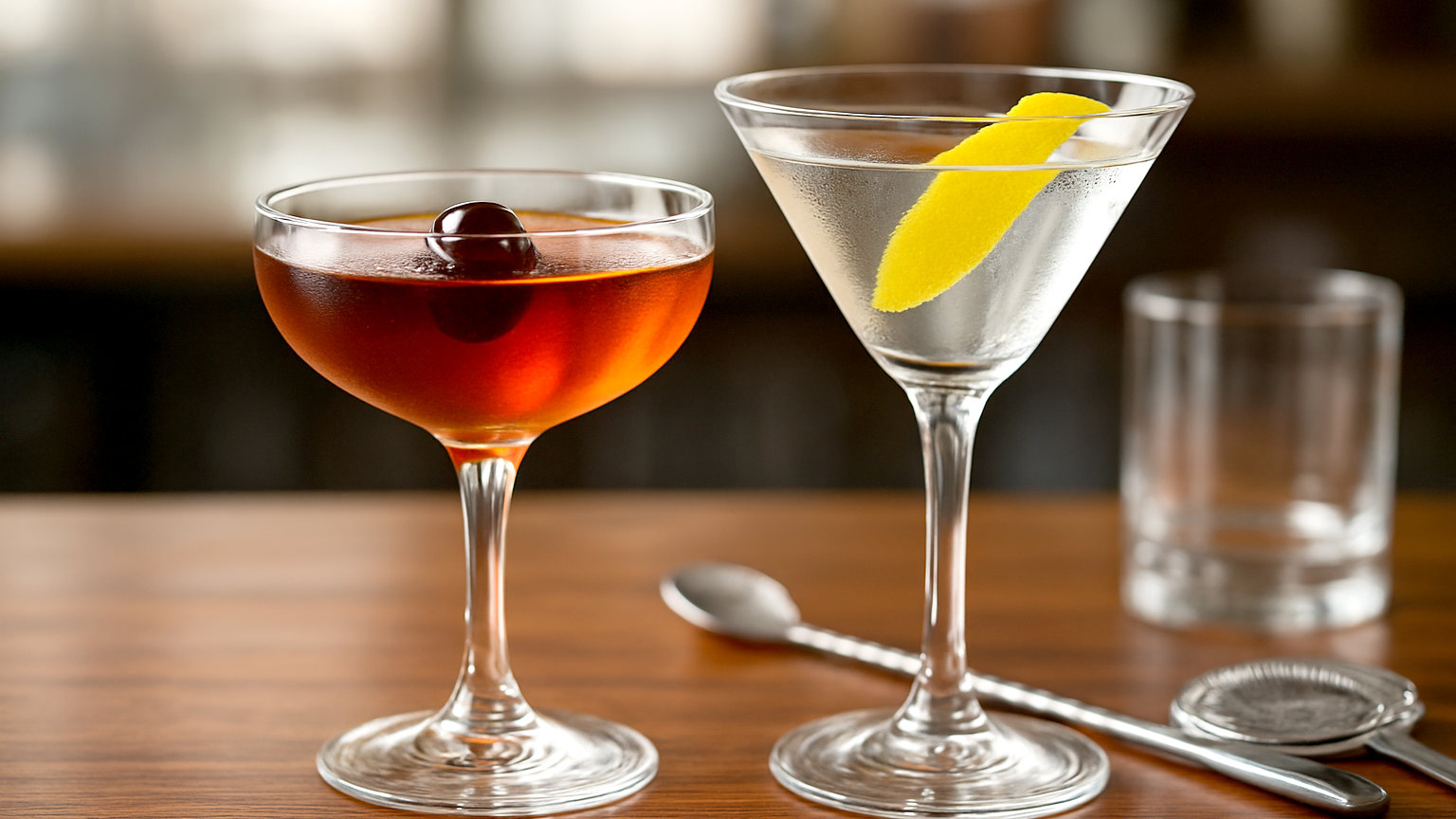
A martini is gin and dry vermouth. A manhattan is whiskey and sweet vermouth with bitters. They are built the same way and they are quite different drinks, which makes the comparison unusually instructive.
The shared structure
Both belong to the spirit-forward stirred family: a base spirit, a fortified wine modifier, optionally bitters, stirred with ice and served up.
Both contain no citrus juice, which is why both are stirred rather than shaken.
Both depend heavily on the vermouth being fresh, and both are ruined by a stale bottle.
Both are served in small glasses because they are strong, and both warm quickly since they contain no ice.
What differs
The base. Gin is aromatic and botanical; whiskey is sweet, oaky and spicy. That changes the whole character before anything else is considered.
The vermouth. Dry vermouth is light, herbal and acidic; sweet vermouth is richer, sweeter and carries caramel, spice and dried fruit.
The bitters. A manhattan almost always contains two dashes of aromatic bitters; a martini traditionally contains none, though orange bitters were standard historically and are worth trying.
The ratio. A martini commonly runs three or four to one; a manhattan runs two to one, since sweet vermouth is less assertive against whiskey than dry vermouth is against gin.
The manhattan recipe
Combine 60 millilitres of rye whiskey with 30 millilitres of sweet vermouth and two dashes of aromatic bitters in a mixing glass with ice.
Stir for thirty seconds and strain into a chilled coupe.
Garnish with a good cocktail cherry, or a lemon twist for a brighter drink.
Where the family goes from there
The structure accepts substitutions freely, and the named variations are a map of what is possible.
Swap the whiskey for Scotch and you have a Rob Roy. For brandy, a Harvard. For aged rum, a variation with no fixed name but a very good drink.
Swap sweet vermouth for dry in a manhattan and it becomes a dry manhattan. Split the vermouth and it becomes perfect.
Swap the gin in a martini for whiskey and add sweet vermouth and you have arrived at a manhattan, which demonstrates that these are two points on the same map rather than two separate drinks.
Which to make when
A martini is bracing, dry and aromatic, which suits it to being drunk before a meal. Its acidity and dryness sharpen the appetite in the way any good aperitif does.
A manhattan is richer, sweeter and more warming, which suits it to after dinner or to a cold evening.
That is a convention rather than a rule, and plenty of people drink both at either end of an evening.
The comparison worth making
Make one of each on the same evening and taste them alongside each other in small measures.
What becomes obvious is how much the vermouth does. The same technique, the same dilution and the same glass produce two drinks with almost nothing in common, and the largest single variable is a fortified wine that most people treat as an afterthought.
It is also a useful demonstration of why both deserve fresh vermouth. Tasting the two vermouths on their own, before making the drinks, takes thirty seconds and tells you immediately whether either bottle needs replacing.
Which to learn first
The manhattan, for most people. It is more forgiving than the martini, since the whiskey and sweet vermouth are both assertive enough to survive a slightly wrong ratio.
A martini at the wrong dilution or with tired vermouth is unmistakably poor, which makes it the better teacher and the harsher one.
Learning the manhattan first and moving to the martini afterwards is the gentler order, and the technique transfers entirely.


