
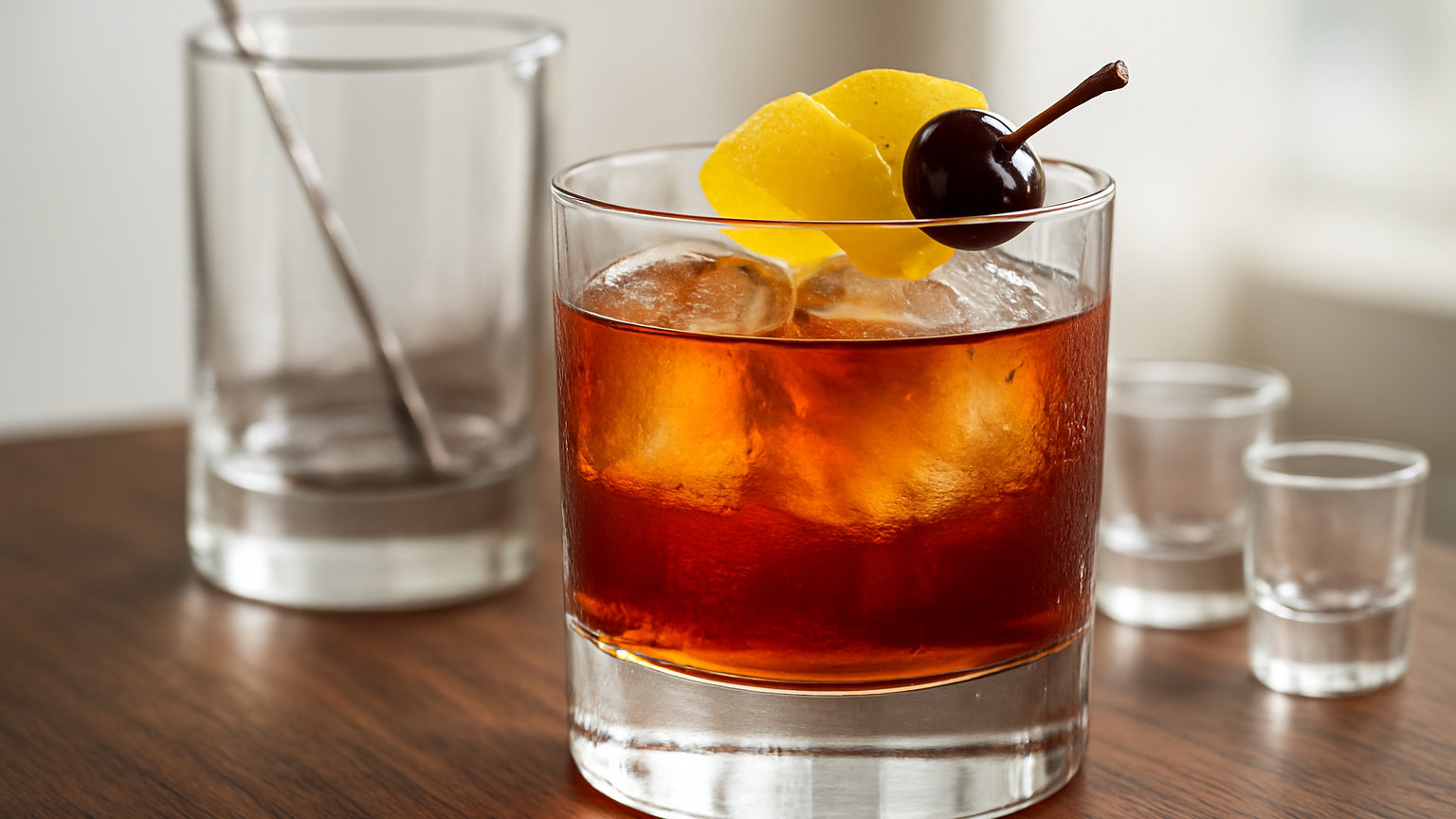
The Vieux Carré is rye, cognac, sweet vermouth, Bénédictine and two kinds of bitters. On paper it looks overloaded. In the glass it is one of the most balanced drinks in the classic canon.
The recipe
Combine 25 millilitres of rye whiskey, 25 millilitres of cognac and 25 millilitres of sweet vermouth with one teaspoon of Bénédictine, one dash of aromatic bitters and one dash of Peychaud's bitters.
Stir with ice for around thirty seconds.
Strain over a large cube in a rocks glass, or into a chilled coupe.
Garnish with a lemon twist expressed over the surface, or a cherry.
Where it comes from
Created at a hotel bar in the French Quarter of New Orleans in the 1930s, and named after the quarter itself, which translates as old square.
It sits alongside the sazerac as the city's contribution to the canon, and the two share a use of Peychaud's bitters, which are local and distinctive.
Why the split base works
Rye and cognac in equal measure is the drink's central idea, and it is worth understanding because the technique generalises.
Rye brings dryness, pepper and grain spice. Cognac brings fruit, roundness and a softer sweetness.
Neither alone would produce what the combination does. The rye keeps the drink from being cloying, and the cognac keeps it from being austere.
Split bases appear throughout modern bartending for exactly this reason, and the Vieux Carré is the classic demonstration.
What Bénédictine does
A herbal liqueur made to a proprietary recipe, honeyed and complex with a great many botanicals and a distinctly medicinal edge.
A teaspoon is the correct quantity. Any more and it dominates, which is true of most herbal liqueurs and is why they appear in small measures.
It supplies honey sweetness and an herbal backbone that ties the whiskey, the brandy and the vermouth together.
A bottle is expensive and lasts for years given the quantities involved, and it also makes a singapore sling, a bobby burns and a monte carlo, so it earns its place.
The two bitters
Using both aromatic and Peychaud's is deliberate. They are quite different: aromatic bitters are spicy and clove-forward, Peychaud's are lighter, anise-driven and faintly cherry-like.
Together they cover more aromatic ground than either alone.
Substituting one for the other produces a perfectly good drink and not this one, and Peychaud's is inexpensive and worth buying if you also intend to make a sazerac.
How it relates to the manhattan
Structurally it is a manhattan with the base split between two spirits and a herbal liqueur added.
That makes it a useful next step for anyone who likes manhattans and wants something more layered, and it demonstrates how the stirred family expands.
It is sweeter and rounder than a manhattan, and considerably more complex.
Why it is underrated
Five ingredients puts people off, and one of them is a bottle few homes have.
It also lacks a memorable one-line description, which matters more for a drink's spread than it should. The penicillin has the smoky float, the espresso martini has the foam, and the Vieux Carré has nothing to say about itself in a sentence.
What it has is balance, and it is among the best arguments for working through the older New Orleans drinks rather than only the famous ones.
Adjusting it
The equal-parts base can be shifted. More rye and less cognac gives a drier, spicier drink; the reverse gives something rounder and more fruity.
Reducing the vermouth to twenty millilitres while keeping the spirits produces a stronger, less sweet version that many bars prefer.
Serving it over a large cube rather than up suits it well, since the drink is rich and benefits from staying cold while you work through it slowly.


