
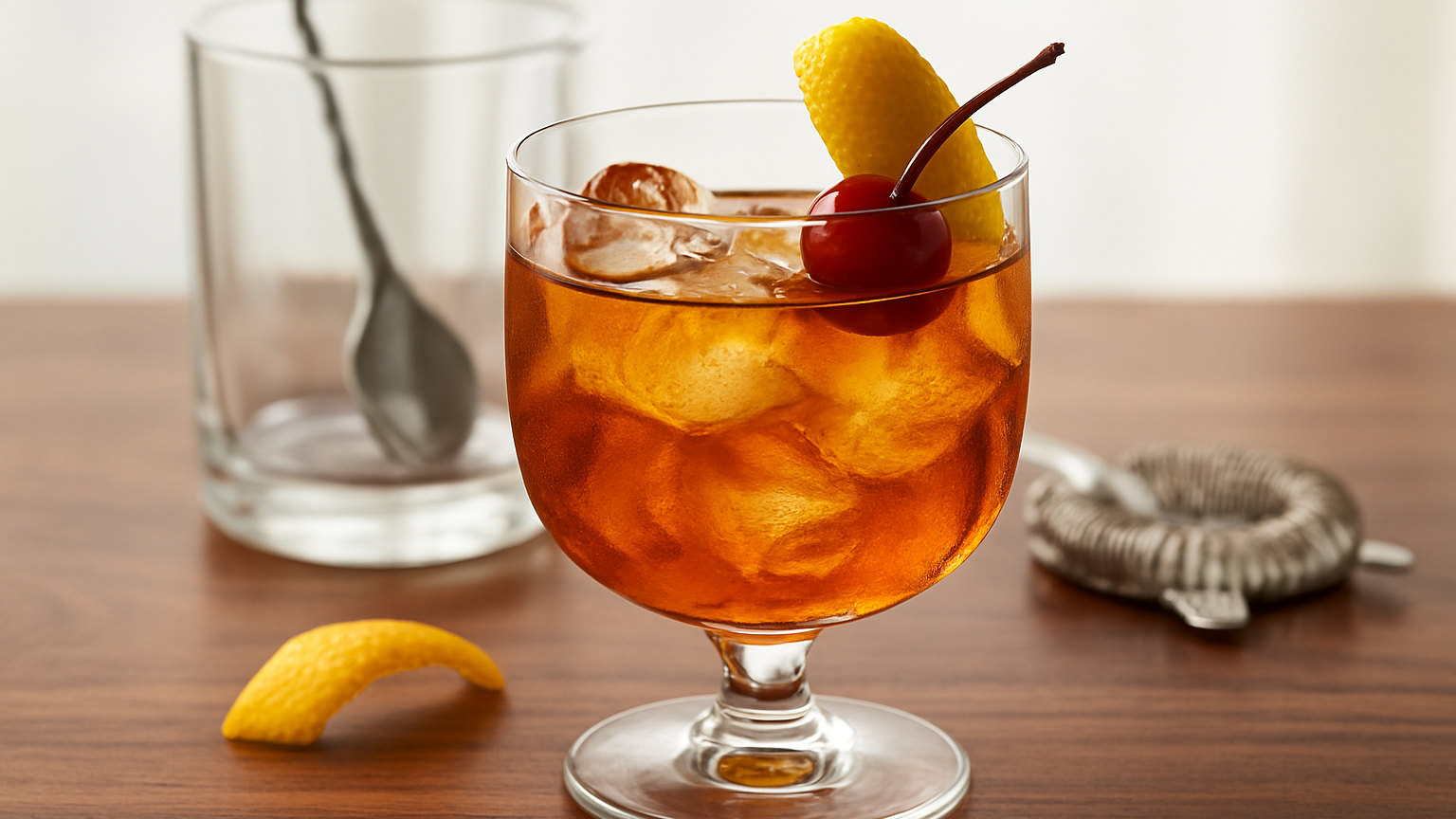
A Rob Roy is a manhattan made with Scotch: whisky, sweet vermouth and bitters, stirred and served up. It is the most straightforward answer to the question of whether Scotch belongs in cocktails.
The recipe
Combine 60 millilitres of blended Scotch with 25 millilitres of sweet vermouth and two dashes of aromatic bitters.
Stir with ice for thirty seconds and strain into a chilled coupe.
Garnish with a cherry, or a lemon twist for a brighter version.
The name comes from a Broadway operetta about the Scottish outlaw, and the drink dates from the 1890s.
Why Scotch has the reputation
Three reasons, and two of them are avoidable.
The first is peat. Heavily peated whisky is assertive enough to dominate almost any drink, and a manhattan made with an Islay malt tastes of smoke and very little else.
The second is cost. People reach for a good single malt, which is both expensive and specifically designed to be interesting on its own, and then mix it with two other things.
The third is a genuine cultural resistance. Scotch drinkers have historically regarded mixing it as close to vandalism, which discouraged experimentation for a long time.
What actually works
Blended Scotch, which is what the drink was built around. Blends are designed for balance and approachability, they are inexpensive, and they mix without dominating.
A decent blend at forty per cent is the right choice for a Rob Roy, and using something expensive is a waste rather than an upgrade.
Lightly peated or unpeated single malts work well, particularly Speyside and Highland styles with honey and orchard fruit character.
Heavily peated whisky works when it is used deliberately in small quantities, which is the technique the penicillin uses with its float.
The Scotch cocktails worth knowing
The Bobby Burns is a Rob Roy with Bénédictine in place of the bitters, which adds honey and herbs and is arguably the better drink.
The Blood and Sand is equal parts Scotch, sweet vermouth, cherry liqueur and orange juice, which sounds unlikely and works.
The penicillin, a modern classic, uses blended Scotch with honey, ginger and lemon, floated with a peated malt.
A Scotch highball with soda over plenty of ice is the simplest and one of the best, and it is treated as a serious drink in Japan.
The rusty nail, Scotch with a honeyed Scotch liqueur, is unfashionable and pleasant.
How peat behaves in a drink
Worth understanding, since it is the main obstacle.
Peat phenols are powerful and persistent, and they do not fade with dilution the way some flavours do. A quarter measure of a heavily peated whisky will be clearly detectable in a finished drink.
They also amplify against soda water, which is why a peated highball is more assertive than the whisky alone suggests.
What peat pairs with successfully is sweetness, honey, citrus and other bold flavours. What it overwhelms is anything delicate.
Using it as a float or a rinse rather than as the base is the reliable approach.
The wider point
The rule that expensive spirits should not be mixed is worth examining rather than accepting.
A cocktail is not a lesser use of a spirit; it is a different one. What is genuinely wasteful is using a spirit whose distinguishing qualities will be lost, which applies to a delicate old malt and not to a good blend.
Choosing the right bottle for the job is the whole of it, and for Scotch cocktails that generally means a blend.
Making it well
Fresh sweet vermouth, kept in the fridge, since it is a third of the drink and a stale bottle ruins it.
Stir rather than shake, and chill the glass thoroughly beforehand.
Taste before straining. Scotch blends vary considerably in sweetness, and a drink that works with one may need a slightly different ratio with another.


