
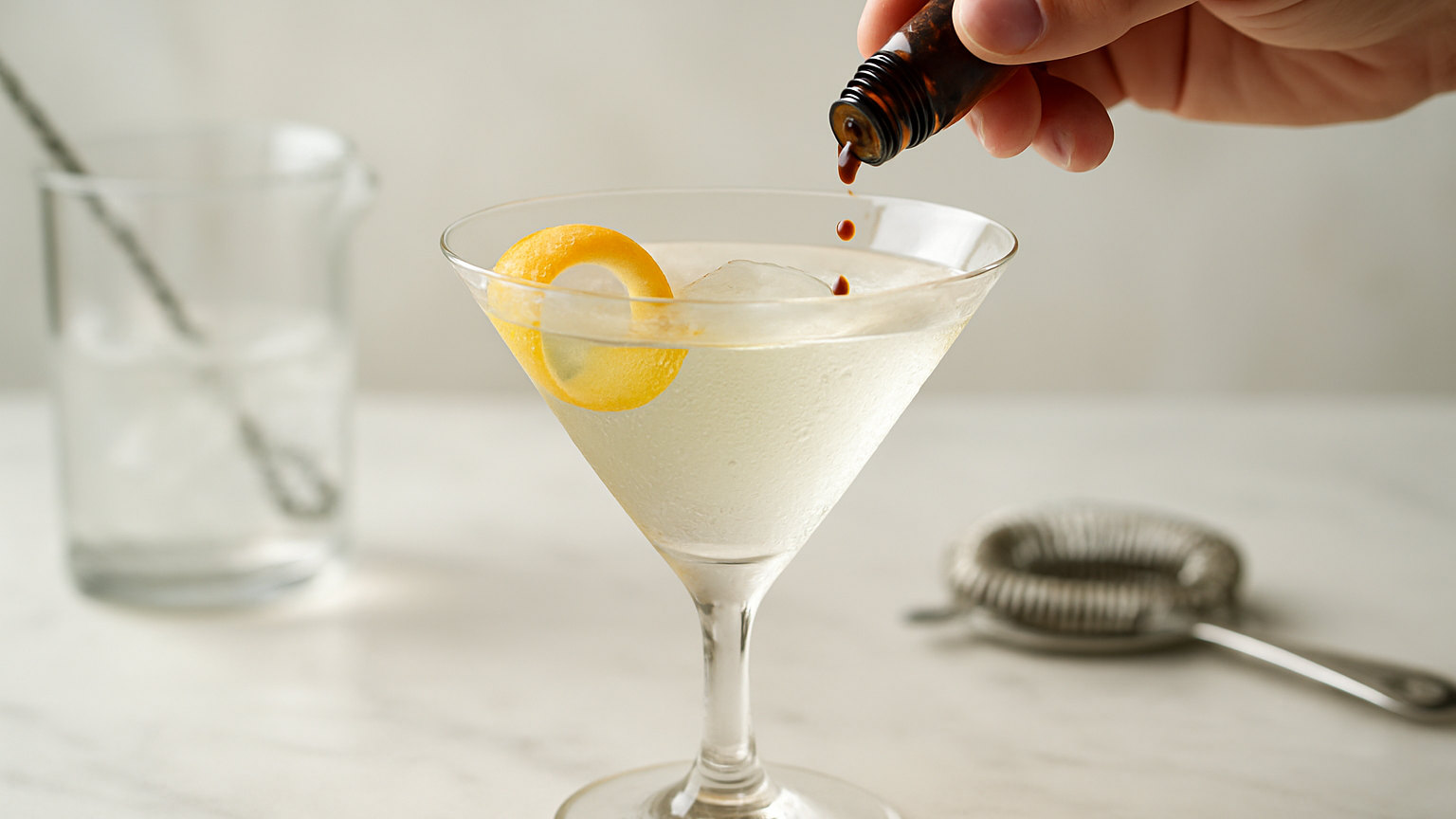
Bitters are concentrated botanical extracts, usually alcohol-based, added to a drink in dashes rather than measures. A few drops in a hundred millilitres of liquid seems too little to matter and changes the drink noticeably.
What they do
Three things.
They add aroma, which is where most of the effect comes from. Bitters are intensely aromatic, and since much of what we call flavour is smell, a small quantity has a disproportionate impact.
They add bitterness, which gives a drink length and structure and stops sweetness dominating.
And they connect components, tying a base spirit and a modifier together into something that reads as one drink. This is the least tangible and the most important: a manhattan without bitters is recognisably missing something even though the two main ingredients are unchanged.
The usual comparison is to seasoning in cooking, and it is accurate. Bitters do for a cocktail roughly what salt and pepper do for a dish.
The main styles
Aromatic bitters are the default. Spicy, clove and cinnamon-forward with a gentian bitterness, and they appear in the old fashioned, the manhattan and a great many others.
Orange bitters are brighter and citrus-driven, and they were standard in martinis before falling out of use. Adding a dash to a martini is worth trying.
Peychaud's bitters are lighter and sweeter than the aromatic style, with anise and cherry character and a red colour. They are essential to the sazerac and the Vieux Carré.
Beyond those sit a large modern category: celery, cardamom, chocolate, grapefruit, lavender and many more. Most homes need none of them, and one or two chosen for drinks you actually make are useful.
How much
A dash from a standard bottle is roughly nought point eight of a millilitre, though it varies with how the bottle is shaken.
Two or three dashes is the usual quantity in a stirred drink. More than that and the bitters begin to dominate rather than season.
Some drinks use them as a garnish, dropped onto a foam, where the aroma reaches the nose directly. That is a different technique and considerably more assertive per drop.
The alcohol question
Most traditional bitters are bottled between about thirty five and forty five per cent alcohol.
The quantity in a drink is tiny, under a millilitre, which is why they are often classified as a flavouring rather than a beverage.
That arithmetic is not the whole answer. Anyone avoiding alcohol for religious reasons, in recovery, taking interacting medication or pregnant may reasonably regard any quantity as unacceptable, and the decision belongs to them.
The practical rule is to say what is in a drink. Alcohol-free bitters using a glycerine base are widely available and solve the problem entirely.
How long a bottle lasts
Years. The alcohol content and the concentration make bitters extremely stable, and a bottle used at two dashes per drink will outlast most people's interest in it.
Keep it out of direct light and it will be fine. The aromatics fade very slowly over a long period, and a bottle open for five years is still usable.
This makes bitters the best value purchase in a home bar. Two small bottles cost less than a bottle of gin and improve a great many drinks.
Making your own
Possible and a considerable commitment. It involves infusing bittering agents, aromatics and a base spirit separately, blending them and resting the result over weeks.
Anyone attempting it should be careful about which botanicals they use, since several traditional bittering plants are not safe to consume in quantity, and gathering plant material requires certainty about identification. Buying dried botanicals from a reputable supplier is the sensible route.
What to buy first
Aromatic bitters, without question. They appear in more drinks than anything else on the shelf and a bottle costs very little.
Orange bitters second, which transform a martini and appear in a great many older recipes.
Peychaud's third, if you intend to make sazeracs or Vieux Carrés.
Everything beyond those three is expansion rather than foundation, and most homes never need it.


