
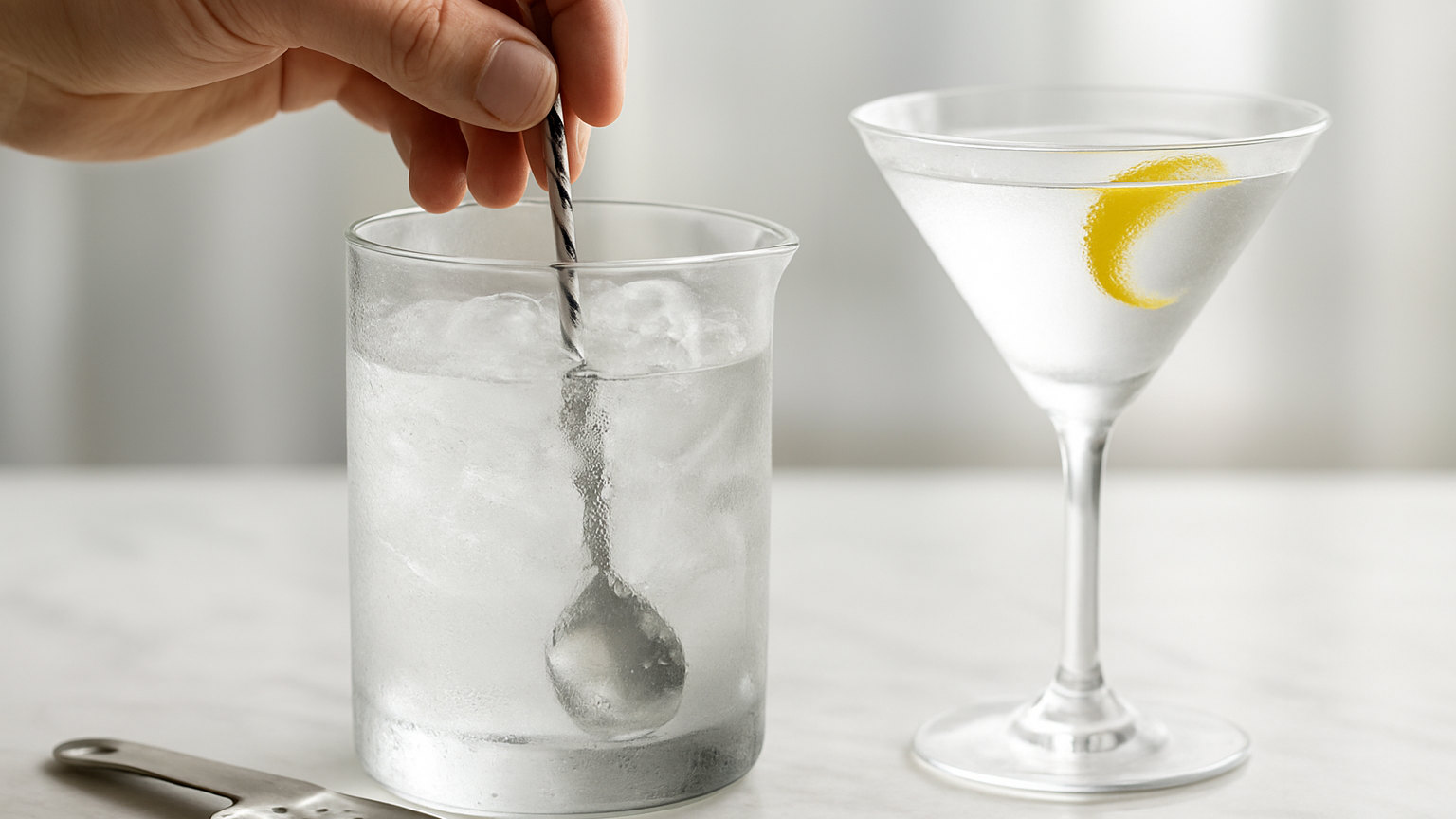
Stirring looks like the part of bartending with the least to it, which is why it is done badly so often. It is doing three jobs simultaneously and each of them affects the finished drink.
What stirring does
It chills, bringing the drink down to around minus one to two degrees.
It dilutes, adding roughly twenty to twenty five per cent of the drink's volume in water. That water is an ingredient rather than an accident: it softens the alcohol, opens the aromatics and brings the drink to its intended strength.
And it combines, integrating the components into something that tastes like one drink rather than several.
What it deliberately does not do is aerate. That is the difference from shaking, and it is why a stirred drink is clear and silky rather than cloudy and light.
The method
Fill a mixing glass at least three quarters full with ice, and add the ingredients.
Insert the bar spoon between the ice and the side of the glass, and rotate it steadily, letting the spiral shaft turn between your fingers while the bowl of the spoon runs around the inside of the glass.
The ice should rotate as a mass rather than clattering about. Aggressive stirring chips the ice, which adds fragments and accelerates dilution unevenly.
Stir for around thirty seconds, or until the outside of the glass is properly frosted and cold to hold.
Judging the dilution
This is the actual skill and it is a matter of feel rather than counting.
The frost on the outside of the mixing glass is the most reliable indicator. When it forms evenly and the glass is uncomfortable to hold, the drink is ready.
Under-stirring produces a drink that is harsh, hot and closed. If a martini or an old fashioned tastes aggressive, the usual cause is insufficient dilution rather than too little sweetener.
Over-stirring produces something thin and flat, where the spirit has been washed out.
Tasting is permitted and sensible. Draw a little up a straw before straining.
The ice matters more than the technique
Large, cold, dry ice straight from the freezer is what you want.
Wet ice that has been sitting out has already begun melting and will dilute far faster and less predictably.
Small ice has more surface area and dilutes quickly, which makes the timing much harder to judge. Larger cubes give you a longer window in which the drink is right.
And fill the glass properly. A half-filled mixing glass dilutes more rather than less, since the smaller mass of ice melts faster against the same volume of liquid.
Equipment
A mixing glass with a weighted base is pleasant and not necessary. A pint glass or a sturdy jug works perfectly well.
A bar spoon with a spiral shaft is genuinely useful, since the spiral is what allows the smooth rotation between the fingers. A long teaspoon is a poor substitute.
A julep strainer, the perforated spoon-shaped one, is traditional for stirred drinks and a Hawthorne strainer does the job equally well.
Chilling the serving glass
The step most often skipped and the one that determines whether the drink is still good three minutes later.
Put the glass in the freezer while you work, or fill it with ice and water and discard that just before straining.
A perfectly stirred martini poured into a room-temperature coupe is warm before you are halfway down it, which undoes the entire exercise.
The showmanship question
Elaborate wrist technique, silent stirring and precise counts are enjoyable to watch and largely irrelevant to the result.
Cold ice, a full glass, steady rotation and thirty seconds produces a properly made drink whether or not it looks impressive.
Scaling for several drinks
Stirring two or three drinks at once works perfectly well in a large enough vessel, and the dilution behaves similarly.
Beyond three, the mass of liquid takes longer to chill and the timing becomes unreliable. At that point batching in advance with measured water is the better approach.
Chill all the glasses before you start, since straining four drinks into warm glasses one at a time means the last is considerably worse than the first.


