
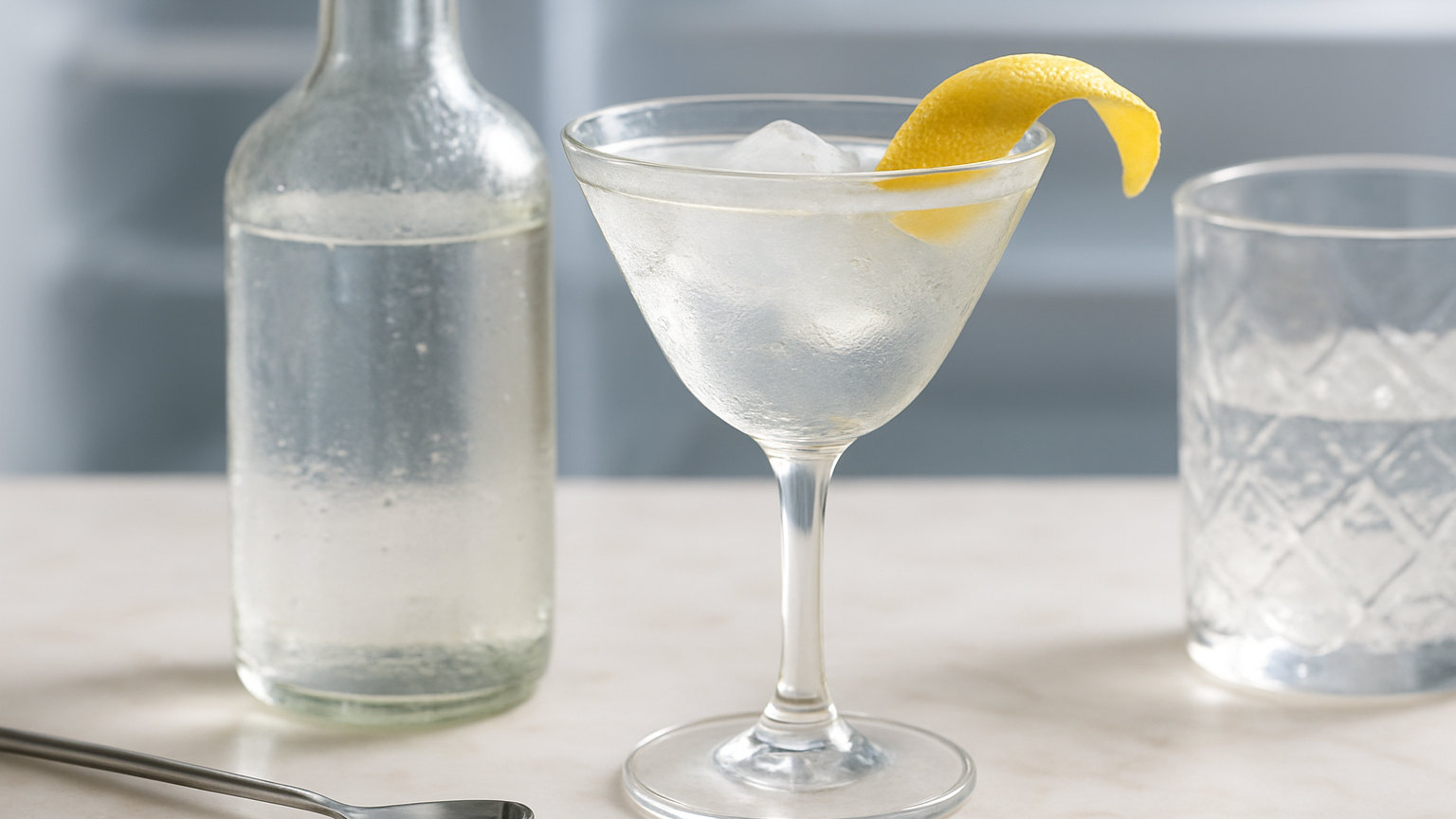
Stirred drinks are the ideal candidates for making in advance. They contain no citrus, no dairy and nothing perishable, which means a bottled negroni or martini keeps for weeks and is served by pouring.
Adding the water
The part that determines whether it works.
A stirred cocktail gains roughly twenty to twenty five per cent of its volume in water from the ice, and that dilution is part of the recipe rather than an accident.
A batch poured over ice will dilute eventually and unevenly, and it will be harsh in the first mouthful.
So add the water in advance. Measure the total volume of ingredients, add twenty to twenty five per cent as filtered water, then taste and adjust.
Taste it cold rather than at room temperature, since chilling flattens sweetness and a batch that seemed balanced warm usually needs a small adjustment.
The freezer martini
The best argument for the whole approach.
Combine gin and dry vermouth in your preferred ratio, add around twenty per cent water, bottle it and put it in the freezer.
The alcohol content keeps it liquid at freezer temperature, and it comes out at around minus eighteen degrees, considerably colder than a stirred martini achieves.
Pour straight into a chilled glass with no ice, no stirring and no dilution. Add the garnish to order.
The result is colder, more consistent and quicker than making one, and a good many bars now serve martinis this way.
The one caveat is that the vermouth should still be fresh when it goes in, since the freezer slows oxidation without stopping it. Use a batch within a month or two.
What else batches well
Negronis, boulevardiers, manhattans and old fashioneds all work perfectly.
Anything made entirely of spirits, fortified wines, liqueurs and bitters is a candidate.
Several of these improve over a few days as the components marry, particularly negronis and manhattans, which is a genuine effect rather than an imagined one.
What does not
Anything with citrus juice, which fades within hours. Anything with dairy or egg. Anything carbonated, where the sparkling element must be added at the moment of serving.
Drinks that depend on a specific texture from shaking do not survive fully, though a brief individual shake recovers most of it.
Bottling and storage
Use bottles that seal properly and fill them close to the neck, since air in the bottle oxidises the contents.
Swing-top bottles work well and look presentable enough to bring to a table.
Refrigerate anything containing vermouth. Freezer storage suits high-strength batches and produces a drink ready to pour.
Keep it dark, as with any spirit.
Label with the contents and the date. This sounds fussy and prevents the common outcome of an unidentified brown liquid in the fridge in six months.
Barrel ageing at home
Small oak barrels sold for the purpose age a batched cocktail, adding vanilla and oak character over a few weeks.
They work, and small barrels have a high surface area relative to volume, so the effect happens fast and over-oaking is easy. Two to six weeks is usually enough, and tasting weekly is essential.
A cheaper approach is a few oak chips or a small oak stave in a bottle, which achieves something similar with more control.
Serving from a batch
Chill the glass. Pour a measured amount rather than filling the glass, since a batch makes it very easy to lose track of how much anyone has had.
Add bitters and garnish to order, since expressed citrus oil fades within minutes.
And write the strength per serving on the label, which is a sensible habit when the drink comes out of a bottle rather than being built in front of you.
Testing before scaling
Make one drink first, note the exact measures, and only then multiply.
Scaling an untested recipe to a litre is how people end up with a bottle of something not quite right and no straightforward way to correct it.
Keep a note of the water percentage that worked, since it varies slightly by drink and having the figure written down saves repeating the arithmetic.


