
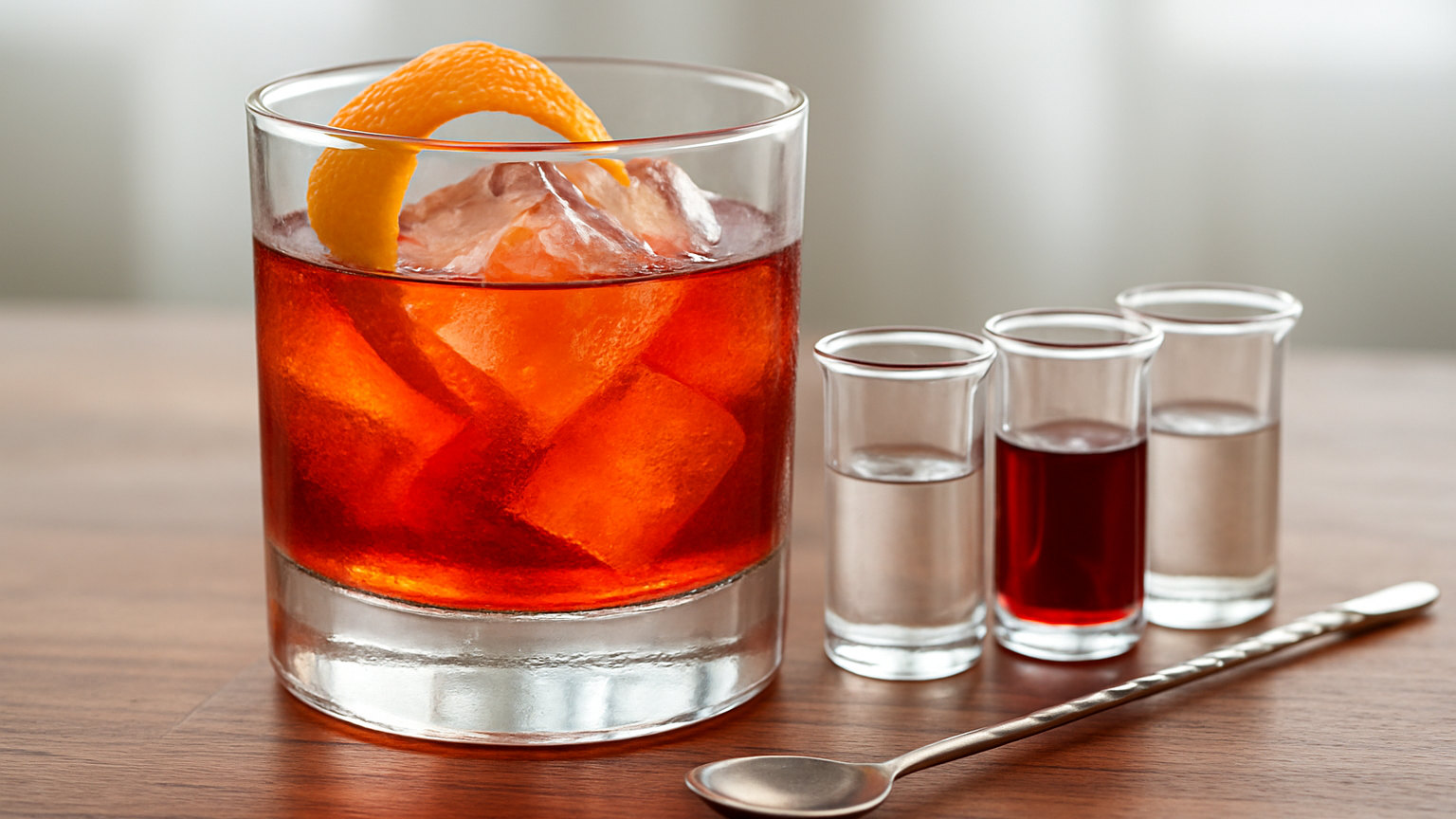
Cocktail recipes are usually a set of unequal measures arrived at through trial and error. A distinct group of them are not: three or four ingredients in identical quantities, balanced without any hierarchy at all.
The format is more common among great drinks than chance would suggest, and there are reasons for that.
The drinks
The negroni is the most famous: gin, bitter aperitivo and sweet vermouth in equal measure.
The last word is gin, green chartreuse, maraschino liqueur and lime juice, four ingredients in identical quantities, and it is one of the more remarkable things anyone has assembled from a shelf.
The corpse reviver number two is gin, orange liqueur, quinine aperitif and lemon juice in equal parts with a dash of absinthe.
Among modern drinks, the paper plane uses bourbon, an Italian amaro, a bitter aperitivo and lemon juice in identical measures, and the naked and famous does the same with mezcal, chartreuse, an aperitivo and lime.
Why it works
The format only functions when every ingredient is assertive enough to survive being one quarter of the drink.
In a last word, chartreuse is powerfully herbal, maraschino is intensely nutty and funky, lime is sharply acidic and gin is aromatic. None is a background component, so none needs a larger share to be heard.
Try the same structure with a neutral vodka, a mild liqueur and a soft mixer and the result is flat, because there is nothing for the proportions to balance.
The other requirement is that the four elements cover the necessary bases: something strong, something sweet, something bitter or herbal, and something acidic. A drink missing one of those is unbalanced whatever the ratio.
The practical advantage
Equal parts drinks are almost impossible to forget, which matters more than it sounds.
A bartender working quickly can build one without measuring precisely. A home drinker can remember it a year later. And a recipe that survives being passed on verbally has a considerable advantage over one requiring three different measures.
Several of these drinks disappeared for decades and were revived from old books precisely because the format made them easy to reconstruct and to spread.
Building your own
The format is an unusually good template for experimenting, because the structure does the work.
Choose a base spirit with character, an herbal or bitter liqueur, a sweeter modifier and an acid. Combine them in equal measures, shake or stir depending on whether citrus is involved, and taste.
Substituting one component at a time from a known drink is the productive approach. The last word with mezcal in place of gin, or with a different amaro, produces recognisable variations, and several of the modern classics were arrived at exactly this way.
What rarely works is substituting something mild into the structure, since the balance depends on everything shouting equally.
When to adjust
Equal parts is a starting point rather than a rule, and plenty of bartenders modify these drinks.
Increasing the base spirit produces a drier, stronger result, which many people prefer in a negroni. Reducing an especially dominant liqueur is sensible where a particular bottle is more assertive than the one the recipe assumed.
The principle to keep is the balance between the four roles rather than the exact arithmetic. If the drink tastes of one thing, reduce that thing; if it tastes of nothing in particular, one of the components is too mild for the format.
Measuring them
Equal parts drinks are the easiest place to start using a jigger properly, since there is only one measure to pour repeatedly.
Common quantities are 22 or 25 millilitres of each for a four-ingredient drink, which gives roughly ninety to a hundred millilitres before dilution, and 30 millilitres each for a three-ingredient one.
That is worth noticing, because these are strong drinks. A last word or a corpse reviver contains a good deal of alcohol in a small glass, and the balance makes them dangerously easy to drink quickly.


