
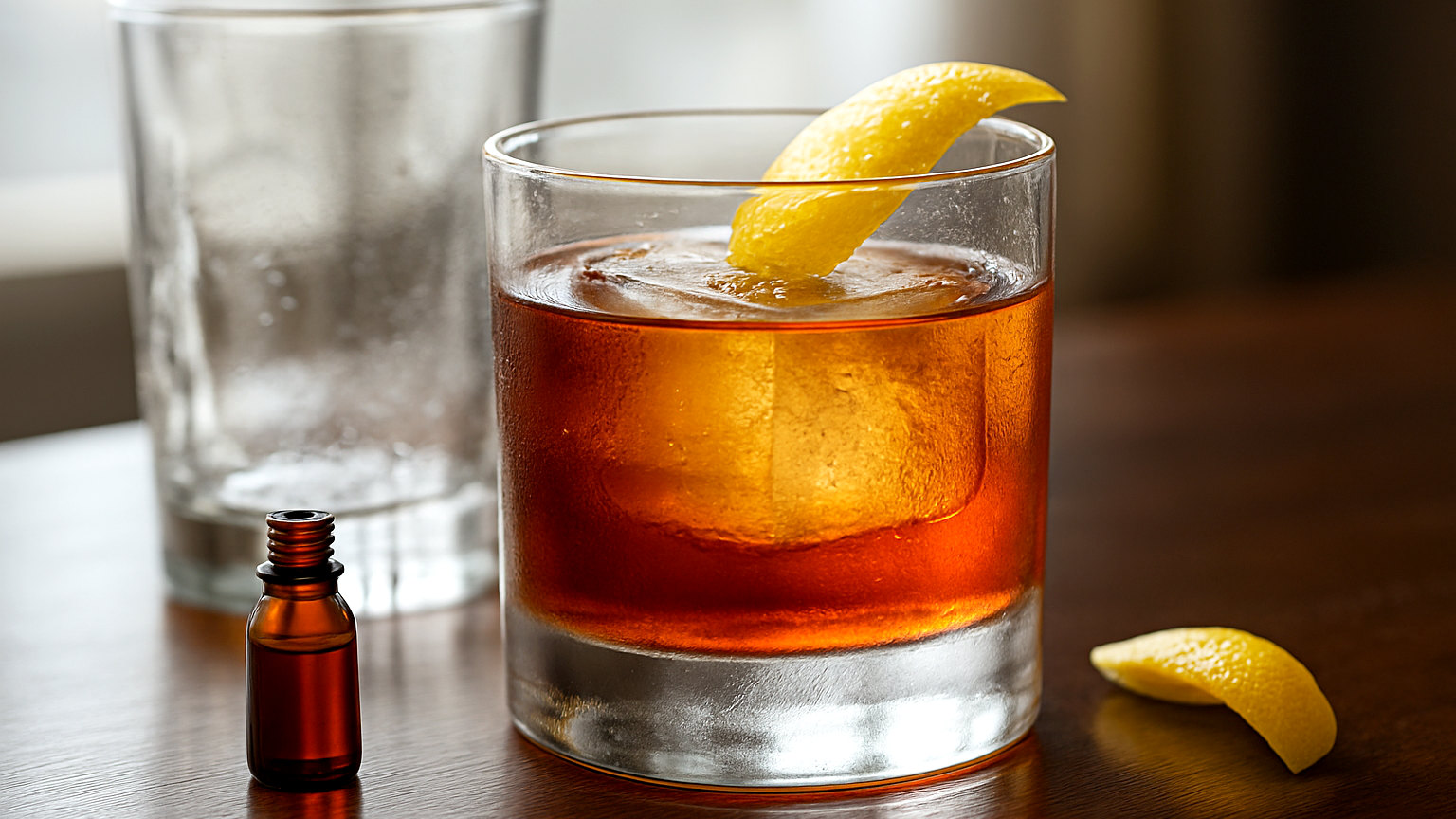
The sazerac is a New Orleans drink and the most ritualised of the classic cocktails. It uses two glasses, a spirit rinse that is discarded, a specific style of bitters and a lemon peel that in the strictest version never enters the drink.
Each element does something, which is the reason the procedure survived.
The recipe
Chill a rocks glass with ice while you work. Meanwhile combine 60 millilitres of rye whiskey, two ounces, with one teaspoon of sugar syrup and three to four dashes of Peychaud's bitters in a mixing glass with ice.
Stir for around thirty seconds until cold and diluted.
Discard the ice from the chilled glass, add a small amount of absinthe, roughly a teaspoon, and swirl it around the inside to coat the whole surface. Tip out the excess.
Strain the whiskey mixture into the coated glass. Express a strip of lemon peel over the surface so the oils land on the drink, then discard the peel rather than dropping it in.
The drink is served without ice, which is unusual for something built in a rocks glass.
Why the rinse rather than a measure
Absinthe is powerful, and anything more than a coating would dominate. A rinse deposits enough anise aroma on the glass to perfume every sip without contributing meaningfully to the liquid.
The technique appears elsewhere in cocktails for the same reason, and it is a useful thing to know generally: where an ingredient is too assertive to measure, coating the glass delivers aroma without flavour.
Absinthe substitutes exist and work adequately. The quantity involved means one bottle lasts a very long time.
The bitters
Peychaud's bitters are integral rather than interchangeable. They are lighter and sweeter than the standard aromatic style, with a distinct anise and cherry character and a bright red colour, and they were created in New Orleans in the nineteenth century.
Substituting ordinary aromatic bitters produces a perfectly pleasant drink that is not a sazerac. If you intend to make the drink, this is the bottle to buy, and it costs very little.
Rye or cognac
The original was made with cognac, and the drink shifted to rye during the nineteenth century, when phylloxera devastated European vineyards and brandy became scarce.
Rye is now standard and gives a drier, spicier drink that suits the anise well. Cognac gives something rounder and more fruity, and it is worth making once to understand where the drink came from.
A split base, using half of each, is a common compromise and arguably the best version of the three.
Why the peel is discarded
The purist instruction is to express the oils over the surface and throw the peel away rather than leaving it in the glass.
The reasoning is that the oil is what you want and the pith contributes a bitterness that develops over the time the drink is being finished. Since the sazerac contains no ice and is drunk slowly, a peel sitting in it has time to affect the flavour.
Plenty of bars drop it in regardless, and nobody will object. The difference is small and real.
Getting it right
Stir rather than shake, since there is no citrus juice in the drink itself and clarity is part of the presentation.
Chill the serving glass properly, because there is no ice in the finished drink and a warm glass will bring it up to room temperature within minutes.
And use a decent rye at forty five per cent or above. With no ice, no citrus and only a teaspoon of sugar, the whiskey is doing nearly all of the work, and a thin spirit has nowhere to hide.
What absinthe actually is
Absinthe is a high-strength spirit flavoured principally with wormwood, anise and fennel, and it was banned across much of Europe and America in the early twentieth century amid claims about its effects that have not held up.
Those bans have since been lifted and the product is legally sold in Britain and elsewhere, subject to limits on one wormwood compound.
For cocktail purposes the quantity involved is a rinse, and any anise spirit of similar character will do the job if absinthe is not to hand.


