
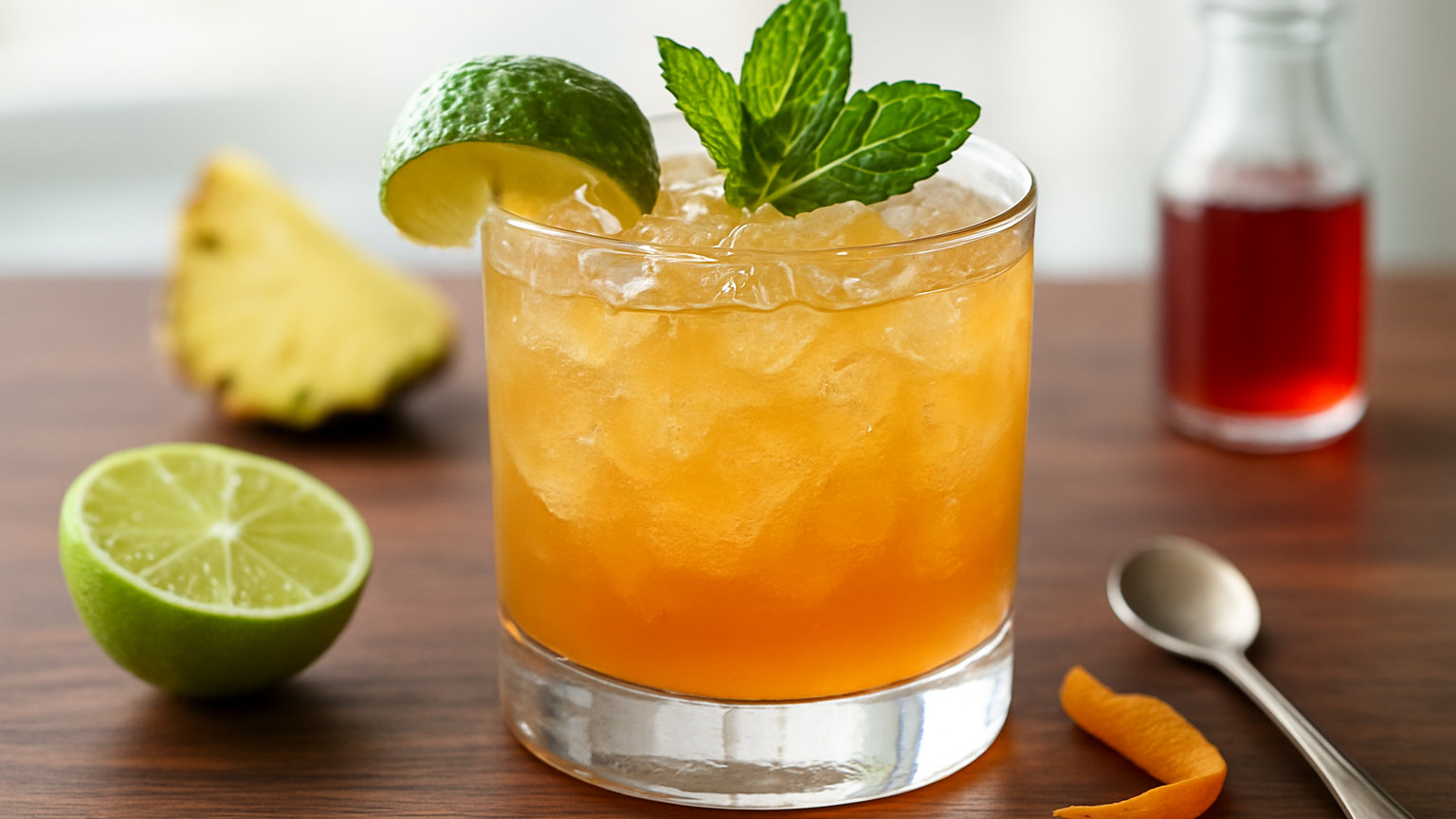
Order a mai tai in most bars and you will receive something orange or red, sweet, full of pineapple and orange juice and topped with grenadine. The original contains none of those things and is a considerably better drink.
The original recipe
The drink is generally credited to Trader Vic in California in 1944, and the recipe is short.
Combine 60 millilitres of aged rum, two ounces, with 15 millilitres of orange curaçao, 15 millilitres of orgeat and 30 millilitres of fresh lime juice. That is half an ounce each of the two sweet components and an ounce of lime.
Shake with crushed ice and pour unstrained into a rocks glass, adding more crushed ice to fill.
Garnish with the spent lime shell and a sprig of mint, placed so the mint sits near the nose as you drink.
There is no fruit juice beyond the lime, no grenadine and nothing that makes it red.
What orgeat is
Orgeat is an almond syrup flavoured with orange flower water, and it is the ingredient that makes the drink work. It supplies sweetness, a nutty richness and a floral aroma that nothing else replicates.
It is widely available and is worth buying properly rather than substituting almond syrup, which is generally sweeter and lacks the floral element.
Once opened it should be refrigerated and used within a few weeks, since it is a dairy-free but perishable product.
The rum
The original called for a specific aged Jamaican rum that is no longer made, and Trader Vic later used a blend of rums to approximate it.
Blending is the sensible modern approach: an aged rum with body and molasses character combined with a funkier Jamaican pot still rum gives depth and aroma that a single rum rarely provides.
An aged rum at around forty five per cent, or a split base with a smaller measure of high ester Jamaican rum, produces something close to the intended drink.
How it went wrong
The drink became enormously popular, and popularity in the mid twentieth century meant volume, speed and cost control.
Orgeat is expensive and perishable, so it was replaced with cheaper syrup or dropped. Fresh lime was replaced with sour mix. Fruit juice was added to bulk the drink out and make it cheaper, and grenadine was added for colour.
Within a couple of decades the name described a fruit punch with rum in it, and a generation of drinkers concluded that tiki drinks were sweet and unserious.
The revival of interest in these drinks over the past twenty years has largely been a matter of returning to the original recipes, which turn out to be dry, strong and balanced rather than sugary.
Ordering one
In an ordinary bar, expect the fruit juice version. In a bar with a serious cocktail list, expect the original.
Asking whether it is made with orgeat is a quick and non-confrontational way to find out which you are getting, and the answer tells you a good deal about the bar generally.
The wider tiki point
The mai tai is not unusual. Most classic tiki drinks are built on the same principles as any other cocktail: a spirit, citrus, a syrup and sometimes a modifier, balanced carefully and frequently using several rums for complexity.
The elaborate garnishes and the presentation are theatre layered over drinks that are structurally conventional, and the good ones are dry and strong rather than sweet.
Anyone who dismissed the category on the basis of a sugary holiday drink is generally dismissing something they have not actually tried.
The ice
Crushed ice is part of the drink rather than a presentational choice. It chills rapidly, dilutes continuously as you drink, and gives the mai tai its shift from strong to long over the course of a glass.
Making it at home is easy: wrap cubes in a clean tea towel and hit them with a rolling pin. Serving the drink over large cubes instead produces something noticeably stronger and less refreshing, which is a different drink rather than a lazier version of the same one.


