
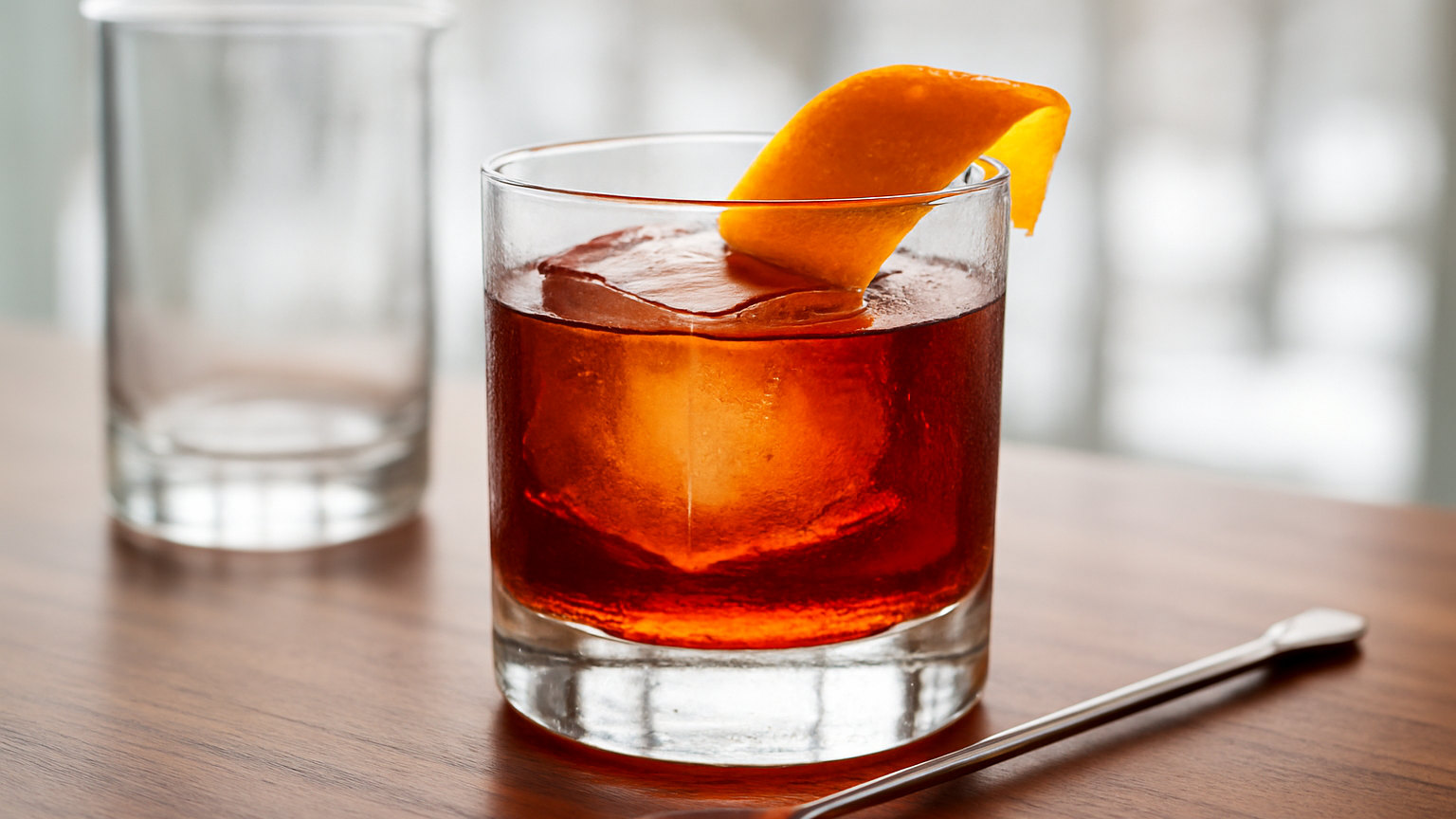
The boulevardier is a negroni made with whiskey instead of gin, and it demonstrates how far a single substitution can move a drink. It is richer, rounder and considerably better suited to a cold evening.
The recipe
Combine 45 millilitres of bourbon or rye, an ounce and a half, with 30 millilitres of red bitter aperitivo liqueur and 30 millilitres of sweet vermouth, an ounce of each.
Stir with ice for around thirty seconds and strain over a large cube in a rocks glass, or into a chilled coupe.
Express an orange peel over the surface and drop it in.
Equal parts also works and produces a bitterer drink. The slightly larger measure of whiskey is the more common modern approach, since bourbon's sweetness needs a little more presence to avoid being buried.
How it differs from a negroni
Gin contributes juniper, citrus and a dry botanical structure that keeps a negroni bracing. Bourbon contributes vanilla, caramel and corn sweetness, along with a fuller body.
The result is a drink where the bitterness sits on top of sweetness rather than alongside dryness. It is less refreshing and more comforting, which makes it a winter drink where the negroni works year round.
Rye in place of bourbon splits the difference, adding pepper and dryness that pushes the drink back towards the negroni's territory while keeping the whiskey character.
The origin
The drink is generally attributed to Erskine Gwynne, an American writer living in Paris in the 1920s who edited a magazine called The Boulevardier, and it appears in Harry McElhone's Barflies and Cocktails in 1927.
That places it as a near contemporary of the negroni rather than a later variation, which is worth knowing, since the two developed alongside each other rather than one being derived from the other.
The related drinks
The old pal replaces the sweet vermouth with dry and uses rye, producing a considerably drier and leaner drink. It is the same three-part structure and a completely different proposition.
The Kingston negroni uses aged Jamaican rum, and the funk and molasses character work unexpectedly well against the bitterness.
A mezcal negroni brings smoke and vegetal character, and it has become a standard on modern lists.
The americano, the ancestor of the whole family, uses soda water in place of the spirit entirely and sits at around ten per cent in the glass, which makes it the sensible option when a full-strength negroni is more than the occasion calls for.
What to look out for
Vermouth freshness, as with every drink in this family. Sweet vermouth is fortified wine and goes stale within weeks of opening. Keep it refrigerated and buy small bottles.
Whiskey strength matters too. Something at forty five per cent or above stands up to the bitter liqueur and the vermouth; a bourbon at forty can be overwhelmed.
And stir rather than shake. There is no citrus juice in the drink, and shaking would aerate and cloud what should be a clear, silky cocktail.
Where it fits
The boulevardier is the drink to make when a negroni feels too sharp, which for many people means autumn and winter.
It also works as an introduction for anyone who finds the negroni's bitterness difficult, since the bourbon's sweetness softens the edges considerably while keeping the structure intact.
Working through the family in order, americano to negroni to boulevardier to old pal, is one of the more instructive exercises available with three bottles, since each step changes exactly one variable.
The name and the ratio
One practical note on ordering. Because the recipe is not fixed, a boulevardier in one bar will be equal parts and in another will lead with the whiskey, and both are correct.
If you have a preference, saying so when ordering is entirely normal and most bartenders will make it either way. Asking for it stirred long and served over a large cube is also a reasonable request, and it produces a better drink than one served in a warm glass over crushed ice.


