
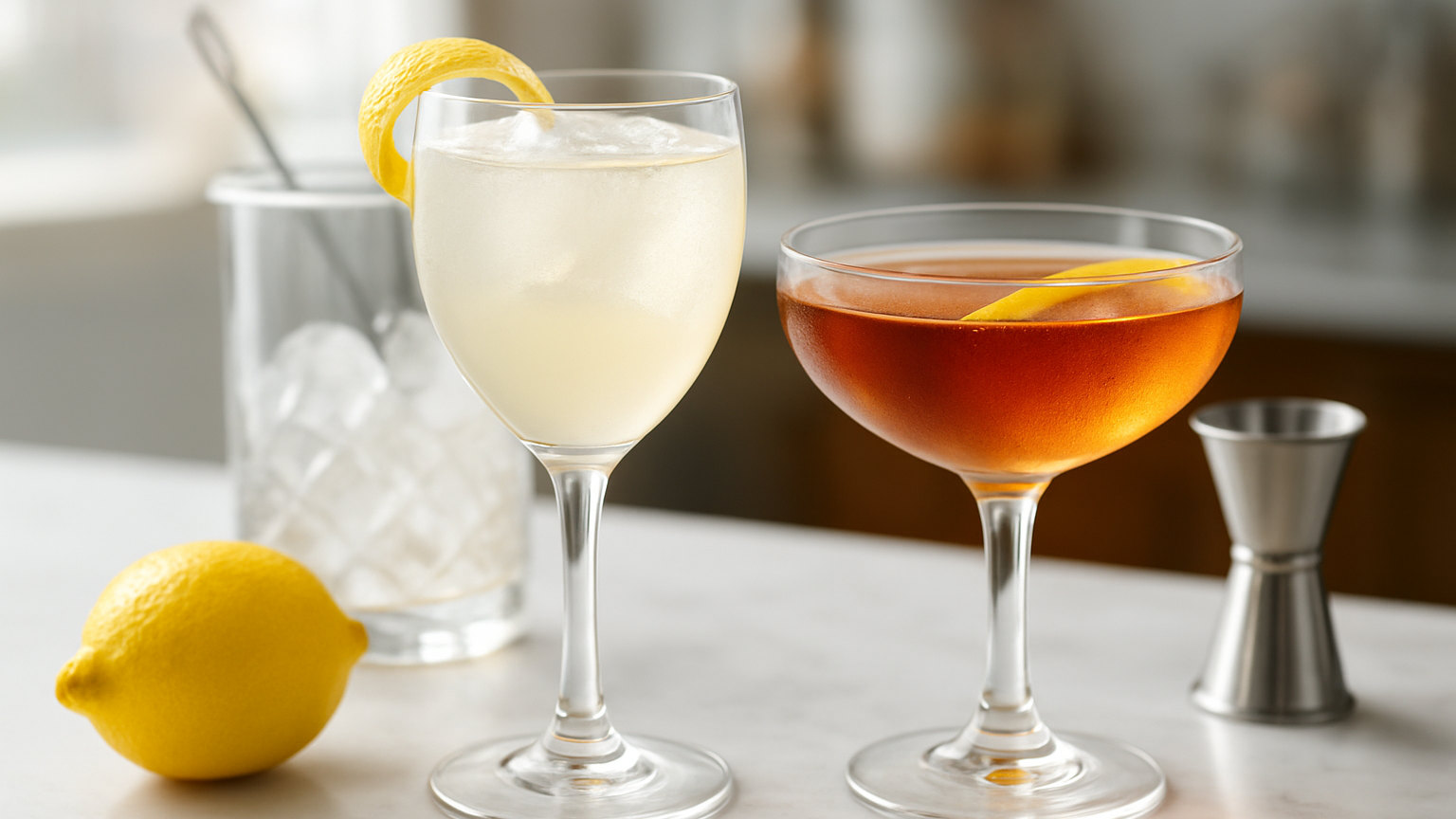
The corpse reviver is a category rather than a single drink, and the name refers to its intended function: a morning drink taken to revive someone who had overdone it the night before. Several were recorded and two survive in general use.
Corpse Reviver Number Two
This is the famous one, and it is among the best gin cocktails ever devised. It appears in the Savoy Cocktail Book of 1930, compiled by Harry Craddock, with the note that four taken in swift succession will unrevive the corpse.
The recipe is equal parts, which makes it easy to remember.
Combine 22 millilitres each of gin, orange liqueur, quinquina aperitif wine and fresh lemon juice, roughly three quarters of an ounce of each. Add a single dash of absinthe, or rinse the chilled glass with it and discard the excess.
Shake hard with plenty of ice and strain into a chilled coupe. A lemon twist finishes it.
The result is bright, citrus-driven and complex, with the absinthe providing an aromatic thread that runs underneath everything else.
The ingredient that changed
The original recipe called for Kina Lillet, a quinine-flavoured aperitif wine that was reformulated in the 1980s to be considerably less bitter.
The modern version of that product works and produces a softer drink. Several other quinine-forward aperitif wines are made specifically to approximate the original character, and they generally give a better result.
This is a recurring problem with pre-war recipes: the drink is a set of proportions, and if one of the ingredients has changed, the balance shifts. Where a classic seems disappointing, an altered component is frequently the reason.
Corpse Reviver Number One
The other survivor is an entirely different drink: spirit-forward, stirred and served without citrus.
Combine 45 millilitres of cognac with 22 millilitres of calvados and 22 millilitres of sweet vermouth. Stir with ice and strain into a chilled glass.
It is rich, warming and apple-scented, and it belongs to the same family as the manhattan rather than to the sour family. Anyone expecting something like number two will be surprised.
Why absinthe appears
The dash of absinthe in number two is easy to skip and should not be. Anise sits underneath the citrus and the gin, tying the drink together in a way that is only apparent once you have made it both with and without.
The quantity is tiny, either a single dash or a rinse of the glass, which means one bottle lasts for years. The same technique appears in the sazerac and elsewhere.
The equal parts family
Number two belongs to a group of drinks built on identical measures, which includes the last word and several modern relatives.
The structure works only when every component is assertive: a strong spirit, a bitter or herbal element, a sweetener and an acid, each capable of holding its own. There is no room for a background ingredient.
The advantage is that they are almost impossible to forget, which is why bartenders like them and why several have become standards.
Making it well
Fresh lemon juice, squeezed to order, since the drink is a quarter citrus and bottled juice ruins it.
Shake hard and double strain, since the drink should be clear and clean rather than carrying ice fragments.
Serve it in a small chilled glass. At roughly ninety millilitres of ingredients before dilution, it is stronger than it tastes, which is presumably what Craddock had in mind with the warning.
The other revivers
Historical books record several more drinks under the name, most of which have not survived and a few of which are worth reviving.
What they have in common is a morning-after purpose, which explains the recurring presence of brandy, vermouth and aromatic components rather than anything refreshing.
It is worth noting that the category rests on an idea that has not aged well. Drinking to relieve the effects of drinking is not something anyone would recommend now, and the name is best treated as a historical curiosity rather than a suggestion.


