Stout and porter are the same family, and asking where one ends and the other begins is a question brewers answer differently depending on who is asking. There is no legal definition of either, and plenty of beers could reasonably carry either name.
What exists instead is a historical relationship and a modern convention, and knowing both makes the shelf considerably easier to read.
The historical relationship
Porter came first, emerging in London in the early eighteenth century as a dark brown beer that became the first industrially produced beer in the world.
Brewers offered it at several strengths, and the strongest version was described as stout porter, using stout in its older English sense meaning strong or robust. The word had nothing to do with colour or with roasted flavour; there were stout pale ales too.
Over time the qualifier dropped away and stout became a noun. By the twentieth century the two were regarded as separate styles, and porter declined so severely in Britain that it effectively disappeared for decades before craft brewers revived it.
The modern convention
The distinction most brewers now work to concerns which dark grain is used, and it produces a genuine difference in the glass.
Stout typically uses roasted barley, which is unmalted grain roasted to a very dark colour. It gives a sharp, dry, espresso-like bitterness and a distinctly coffee character, along with a slightly astringent edge that defines the dry Irish style.
Porter typically uses chocolate malt and brown malt, which are malted grains kilned to a lesser degree. These give a softer, rounder character with cocoa, toast and caramel, and less of the burnt edge.
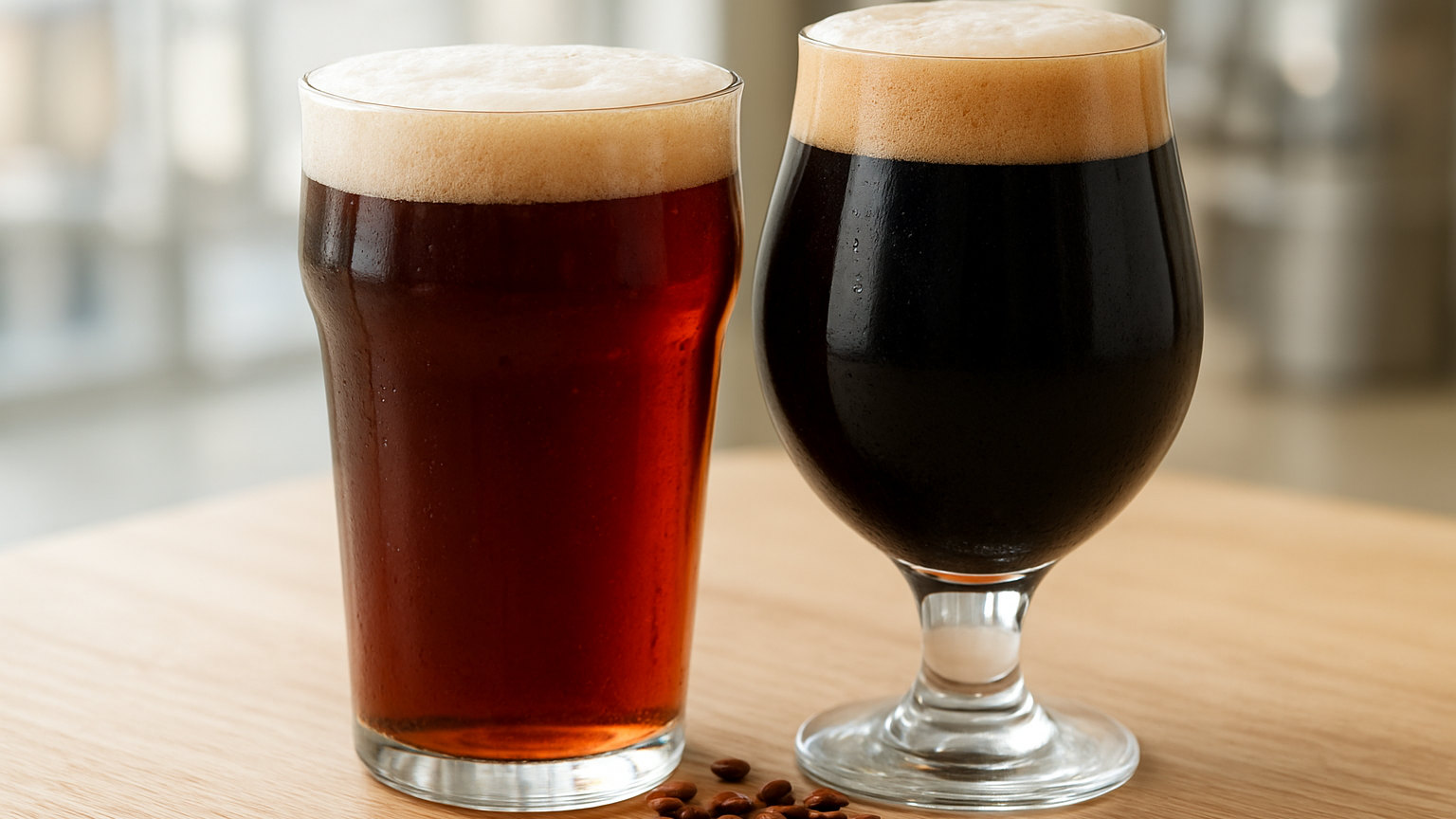
The practical result is that stout tends towards coffee and porter towards chocolate, with stout drier and porter softer. Tasted side by side the difference is clear, even though nothing prevents a brewer from labelling either one as they please.
Where the convention breaks down
Immediately, in several places. Baltic porter is a strong lager, fermented cold, which puts it outside the ale family altogether. Imperial stout at ten per cent has more in common with barley wine than with a four per cent Irish stout.
Milk stout contains lactose and is sweet. Oatmeal stout is built on texture. Pastry stout contains vanilla, cacao and sometimes marshmallow.
Meanwhile some breweries produce a porter that is drier and more roasted than their stout, simply because the recipes developed that way. The names are conventions rather than rules, and treating them as a guarantee will occasionally mislead you.
What actually predicts the beer
Three things on the label carry more information than the style name.
Strength tells you the category: four to five per cent means a session dark beer, six to eight means something substantial, above eight means an imperial style intended for sipping.
The qualifier tells you the direction. Dry, Irish, oatmeal, milk, sweet, imperial, Baltic and pastry all describe genuinely different beers, and they are far more informative than the choice between the two main nouns.
Any mention of adjuncts, meaning coffee, vanilla, lactose, cacao or barrel ageing, tells you what has been added and is usually the dominant flavour.
Does the distinction matter?
Less than the amount of argument it generates would suggest. If you enjoy a beer that tastes of coffee and dryness, look for stout. If you prefer something softer and more chocolatey, look for porter. Those tendencies hold often enough to be useful.
Beyond that, treating them as one family with a wide range of expressions is closer to the truth than defending a boundary that brewers themselves ignore.
The clearest way to understand the difference is to buy one of each from the same brewery, since the house character will be constant and the grain difference will be the variable. That comparison teaches more than any definition, and it explains why the argument persists despite nobody being able to settle it.